Twenty years ago, thermal management was rarely considered a primary concern in industrial control cabinet design. Most electrical enclosures housed contactors, relays, small PLCs, and low-power drives that generated relatively little heat. Standard ventilation or natural convection was often sufficient to keep internal temperatures within an acceptable operating range.
Today's industrial automation systems are fundamentally different.
A modern control cabinet may integrate multiple high-power variable frequency drives (VFDs), servo amplifiers, industrial PCs, edge computing devices, managed Ethernet switches, safety controllers, and high-efficiency power supplies. Although these devices are more energy-efficient than previous generations, they collectively generate significantly higher thermal loads because of increased power density and continuous operation.
As manufacturing plants move toward Industry 4.0, predictive maintenance, machine vision, robotics, and AI-assisted production, the electrical enclosure has evolved from a simple protection box into a high-density computing and power distribution center. Consequently, cabinet cooling is no longer an optional accessory added after commissioning—it has become an engineering decision that directly affects equipment reliability, production continuity, maintenance costs, and energy efficiency.
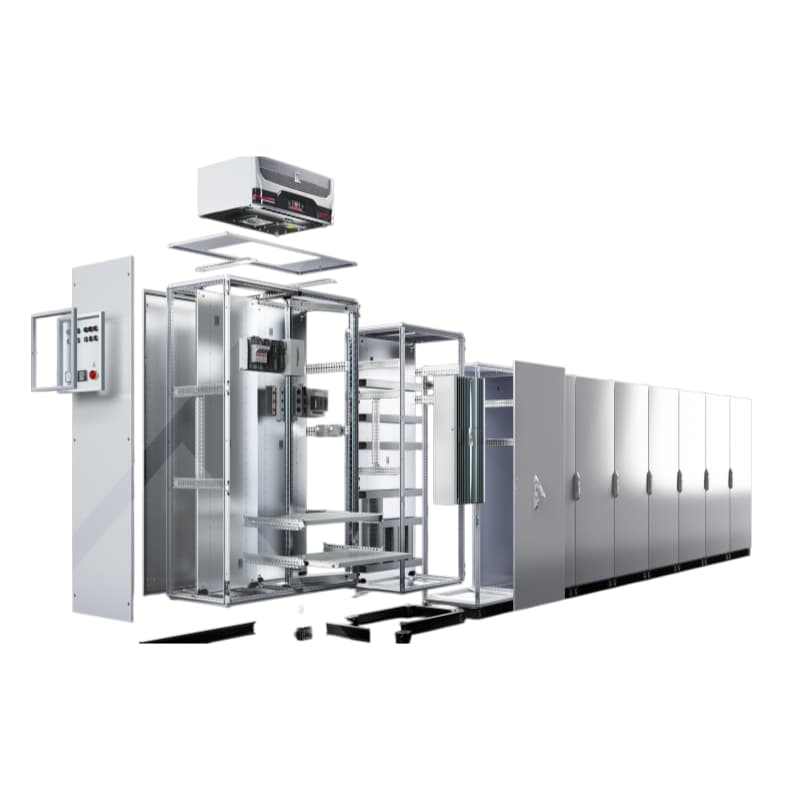
The Growing Thermal Challenge Inside Modern Control Cabinets
One of the biggest misconceptions in industrial automation is that higher efficiency means lower cooling requirements.
In reality, improving component efficiency does not eliminate heat generation. It simply reduces the percentage of input energy converted into heat.
Consider a 15 kW variable frequency drive operating at 97% efficiency.
| Parameter |
Value |
| Drive Rating |
15 kW |
| Efficiency |
97% |
| Input Power |
15.46 kW |
| Output Power |
15.00 kW |
| Heat Loss |
≈460 W |
This means a single drive continuously releases approximately 450–500 W of heat into the enclosure during full-load operation. In a cabinet containing four identical drives, the total heat load can exceed 1.8 kW, even before considering PLCs, power supplies, braking resistors, communication switches, or industrial PCs. Similar heat-loss values are commonly used in enclosure thermal design because VFD efficiencies of 96–98% still produce several hundred watts of dissipated heat at industrial power levels.
During retrofit projects, we often find that the original cabinet had sufficient cooling capacity when it was first commissioned. However, after several years of upgrades—adding servo drives, industrial Ethernet switches, remote I/O modules, and edge computing devices—the enclosure heat load increases significantly while the cabinet dimensions remain unchanged. This gradual increase in power density is one of the most common reasons thermal problems appear in existing production lines.
Machine builders seek to reduce cabinet size to save floor space and transportation costs, while simultaneously integrating more electrical equipment into the same enclosure. The result is a dramatic increase in heat density rather than simply higher total heat.
Unlike open industrial environments, an enclosed cabinet has limited opportunities for natural heat dissipation. Without properly designed airflow or active cooling, internal temperatures continue rising until thermal equilibrium is reached—often well above the recommended operating range of sensitive electronics.
Heat Does Not Damage Equipment Overnight
Many maintenance engineers associate overheating with alarm messages or emergency shutdowns.
However, catastrophic failures are usually the final stage of a much longer degradation process.
Most electronic components experience accelerated aging when operating at elevated temperatures. Electrolytic capacitors, one of the most temperature-sensitive components in drives and power supplies, are a typical example. According to the widely used Arrhenius lifetime relationship, reducing the operating temperature of an electrolytic capacitor by approximately 10°C can roughly double its service life, while sustained higher temperatures significantly accelerate electrolyte evaporation and aging.
The same principle applies to semiconductor devices, insulation materials, relays, communication modules, and electronic connectors.
Excessive cabinet temperature contributes to:
- Faster insulation degradation
- Reduced capacitor lifetime
- Increased semiconductor junction temperature
- Higher failure probability of power electronics
- Drift in measurement accuracy
- Reduced communication reliability
- More frequent thermal alarms
- Unexpected production interruptions
These failures rarely occur immediately after installation. Instead, they accumulate over months or years, making thermal management a lifecycle engineering issue rather than simply a commissioning concern.
Environmental Conditions Often Matter More Than Cooling Capacity
Another common design mistake is selecting a cooling product solely according to its nominal cooling capacity.
Experienced engineers first evaluate the operating environment before choosing any thermal management solution.
For example, a filter fan may perform well inside a clean electronics assembly plant where ambient temperatures remain below 30°C and airborne contamination is minimal. The same solution can become unsuitable in a steel mill, cement plant, woodworking facility, or food processing line where dust, oil mist, moisture, or corrosive vapors are present.
In these environments, introducing outside air into the enclosure may contaminate electrical components, block airflow, accelerate corrosion, or create condensation risks.
Therefore, the first engineering question should never be:
"Which cooling unit should I buy?"
Instead, it should be:
"Can the surrounding environment safely exchange air with the enclosure?"
The answer to that single question often determines whether a filter fan, closed-loop enclosure air conditioner, or liquid cooling system is appropriate.
Cabinet Cooling Is Closely Connected to Energy Efficiency
Thermal management is often viewed only as a reliability issue, yet it also has a direct impact on operating costs.
An oversized enclosure air conditioner cycles more frequently, increasing compressor wear and electricity consumption. Conversely, an undersized cooling system may operate continuously without maintaining the required internal temperature, reducing both efficiency and equipment life.
Modern energy-efficient cooling technologies, such as variable-speed compressor systems and hybrid cooling concepts, aim to provide cooling only when required instead of operating continuously at full capacity. The engineering objective is therefore not to install the largest possible cooling unit, but to achieve stable cabinet temperatures with the lowest practical energy consumption over the equipment's service life.
Engineering Insight
In many industrial projects, overheating is treated as a maintenance problem because it becomes visible only after alarms appear. From an engineering perspective, however, overheating is usually a design problem rather than an equipment problem.
Over the past decade, control cabinets have evolved into compact platforms that combine power conversion, motion control, networking, and industrial computing within increasingly limited enclosure space. As component power density continues to rise, thermal management should be considered during enclosure layout, component selection, airflow planning, and system integration—not after the machine has been commissioned.
Successful cabinet cooling begins long before selecting a cooling unit. It starts with understanding how heat is generated, how it moves inside the enclosure, and how the surrounding environment influences the entire thermal system.
Understanding why control cabinets overheat is only the first step. The next engineering challenge is determining where the heat actually comes from. Before selecting any cooling solution, engineers must identify the major heat-generating components and estimate the total thermal load inside the enclosure.
If you would like to understand how different components contribute to enclosure temperature, read our Understanding Heat Generation Inside Electrical Cabinets guide.