A VX25 stainless steel enclosure is not automatically the right choice for every industrial control system. It becomes a strong candidate when the installation combines a need for modular baying architecture with credible corrosion, moisture, cleaning, or hygiene risks. In a dry electrical room with controlled humidity and no chemical exposure, a correctly specified painted carbon-steel VX25 enclosure may meet the project requirement more economically.
The practical question is therefore not whether stainless steel is “better.” It is whether the environment can degrade a painted enclosure, whether that degradation would create an unacceptable operational or hygiene risk, and whether the selected VX25 configuration supports the way the panel will be built, expanded, cooled, and maintained.
This guide provides a decision path for engineers, panel builders, and procurement teams. It covers the material choice without treating “stainless steel” as a complete specification.
Begin with the real operating environment
Labels such as “indoor,” “outdoor,” and “harsh environment” are too broad for enclosure material selection. A useful site description should answer five questions:
- Will moisture reach the cabinet as condensation, splash, rain, or hose-directed water?
- Are salts, corrosive vapors, process residues, or sanitation chemicals present?
- How often is the surface cleaned, and at what pressure and temperature?
- Does the installation have a hygiene requirement beyond corrosion resistance?
- Could abrasion, impact, drilling, or future modifications damage a painted finish?
Assess these exposures together. High humidity alone does not automatically require stainless steel, while an indoor enclosure may still face aggressive vapors, washdown, or chloride deposits. Rusted fasteners, damaged coatings, staining, and repeated seal replacement on nearby equipment provide useful site evidence. Also consider consequence: repairable cosmetic damage is different from corrosion that could undermine sealing, bonding, hygiene, or electrical protection.
How the main exposure factors change material selection
Corrosion.Stainless steel is valuable when salt, process vapors, fertilizer dust, cleaning residues, or coastal air create sustained corrosion risk. Look beyond appearance to seams, cut edges, fasteners, bonding points, doors, and gasket-supporting surfaces.
Rittal’s published data for the referenced VX25 stainless steel range identifies 1.4301/AISI 304 for the frame and major external panels. That is a defined material grade, not universal chemical compatibility. Sites with high chloride exposure or other aggressive chemicals need an application-specific review of the stainless grade, hardware, seals, and surface treatment.
Humidity and condensation. Record temperature swings, maximum relative humidity, dew point, shutdown conditions, and wet-door-opening events. Stainless steel may limit external corrosion, but it cannot prevent internal condensation; heaters, drainage, ventilation, or closed-loop cooling may still be required.
Washdown. Separate ingress protection, corrosion, cleaning chemistry, and geometry. Define whether cleaning uses wipe-down, low-pressure spray, hose-directed water, high-pressure spray, or steam, together with pressure, temperature, duration, and direction.
The complete installed assembly—not only the empty enclosure—must meet the required protection level. Doors, seals, cable entries, windows, operator devices, cooling equipment, and field cut-outs can determine the result. NEMA Type 4X includes an additional level of corrosion protection as well as protection against hose-directed water, while an IEC IP code addresses solids and water ingress. The two systems should not be treated as interchangeable labels.
Cleaning and sanitation.Frequent cleaning increases wet/dry cycles and contact with detergents or disinfectants. Rittal publishes VX25 stainless steel variants with 400-grit brushed exterior surfaces, but this does not make every VX25 enclosure suitable for a hygiene-critical zone. Rittal’s separate Hygienic Design range addresses cleaning-focused geometry; classify the hygiene zone before choosing between the ranges.
Chemical exposure.Compatibility depends on substance, concentration, temperature, contact time, residues, and mixtures. Include process chemicals, sanitation agents, releases, and airborne vapors, then check gaskets, locks, hinges, glands, labels, windows, and climate-control equipment as well as panels.
Stainless steel vs. painted carbon steel
Painted carbon steel remains a rational choice when the coating can stay intact and the environment does not create an unacceptable corrosion or sanitation risk. Stainless steel becomes more compelling as exposure becomes recurrent, coating damage becomes likely, or cleaning requirements make a painted surface difficult to maintain.
| Project condition |
Painted carbon steel may be sufficient when… |
Stainless steel deserves stronger consideration when… |
| Dry indoor area |
Temperature and humidity are controlled, with no washdown or significant chemical exposure. |
Corrosive vapors or process residues may reach the enclosure. |
| Humid area |
Condensation is limited and controlled, and coating damage can be inspected and repaired. |
Condensation is frequent, persistent, or combined with contaminants. |
| Washdown |
Cleaning is light and infrequent, and the complete assembly meets the required ingress protection. |
Hose-directed cleaning is routine, or corrosion and surface damage are credible risks. |
| Chemical exposure |
Contact is brief or unlikely, and the coating and seals are compatible. |
Chemical contact is repeated and the selected stainless grade and components are verified as suitable. |
| Hygiene-controlled area |
The enclosure is outside the critical hygiene zone and its finish and geometry are acceptable. |
The zone requires cleanable, corrosion-resistant construction and hygienic design has been assessed separately. |
Compare the consequence of surface degradation with the cost of prevention. If deterioration would be visible, repairable, and unrelated to hygiene or electrical protection, painted steel may be appropriate. If it could be rapid, hidden, difficult to repair, or unacceptable to the process, stainless steel can reduce risk—provided the grade and configuration are suitable.
When stainless steel is unnecessary over-specification
A VX25 stainless steel enclosure may be unnecessary in a dry, climate-controlled indoor area without frequent washdown, persistent condensation, meaningful chemical exposure, or a hygiene-driven material requirement—especially when the paint system can be inspected and repaired.
The additional budget may create more value in cable-entry sealing, thermal management, monitoring, segregation, spare capacity, or maintainable layout. Stainless steel should not compensate for an undefined environment or incomplete ingress specification.
Why VX25 architecture matters after the material decision
Material answers what the exposed enclosure structure should be made from. Architecture determines how the control system will be assembled, bayed, transported, wired, expanded, and serviced. Selecting the right metal does not guarantee a practical panel layout.
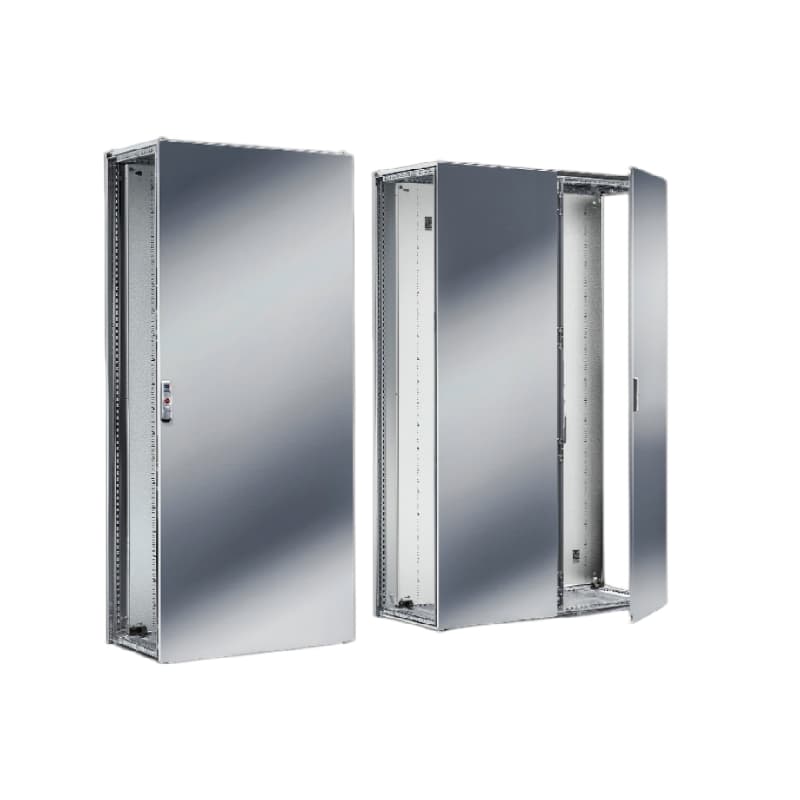
Rittal describes the VX25 platform as using a symmetrical 25 mm pitch pattern, mounting levels accessible from multiple sides, standardized baying concepts, and partially tool-free assembly features. For panel builders, these characteristics can support repeatable internal layouts and multi-cabinet systems. For plants already standardized on VX25, a common architecture may also reduce avoidable redesign of mounting and baying concepts.
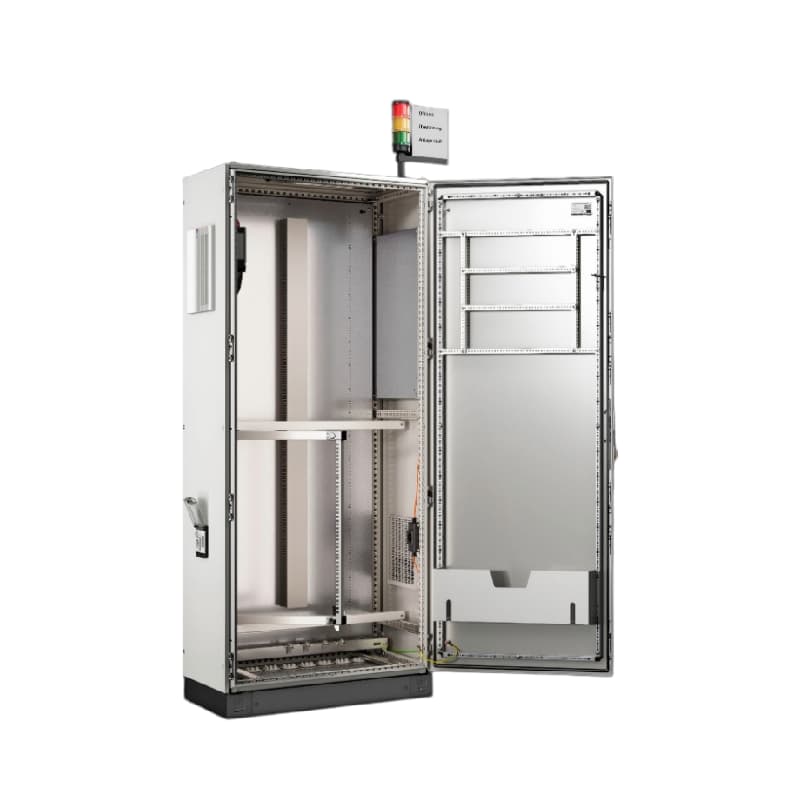
That does not mean every existing accessory fits every stainless steel variant. Enclosure dimensions, article numbers, material-specific fasteners, loads, baying arrangement, and the required protection rating still need configuration-level verification.
After confirming the environment and material direction, use the Rittal VX25 enclosure system page to review the architecture, dimensions, configurations, and accessories.
Digital engineering: connecting configuration to maintenance
RiPanel can configure an enclosure in 3D, add accessories and machining requirements, apply plausibility checks, and export technical data. RiPanel Processing Center can then collect design data, quantities, and target dates and convert them into machine jobs. A Perforex machining centre can use compatible data to produce holes, threads, and cut-outs in enclosure panels, including machinable stainless steel.
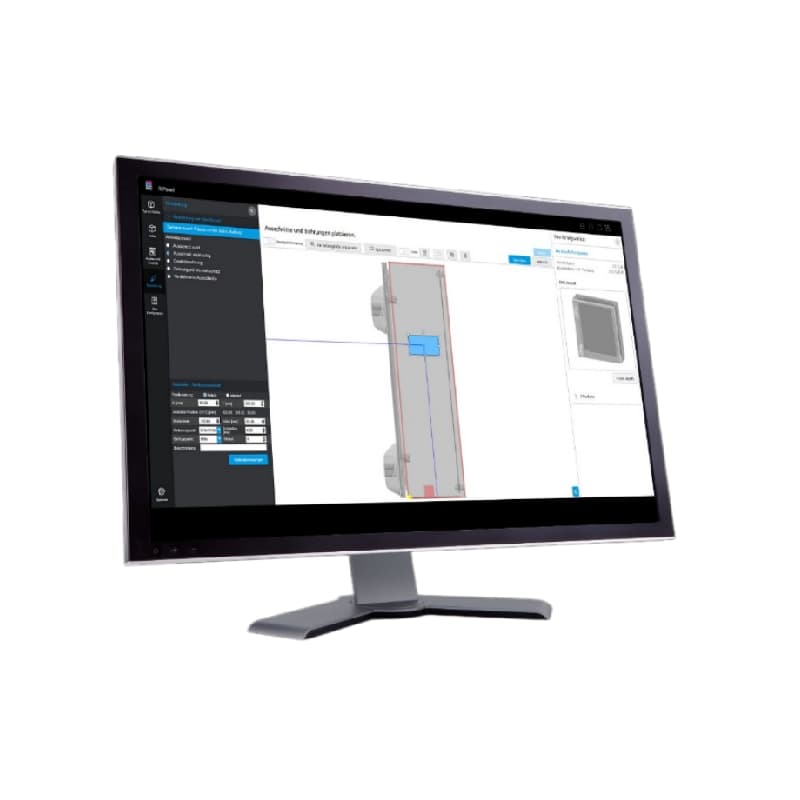
Rittal ePOCKET extends the data chain by providing a digital location for equipment and system documentation linked to a Rittal enclosure. Authorised users can access current information during commissioning, troubleshooting, and maintenance. The workflow is RiPanel configuration → engineering and 3D data → production planning → Perforex machining → documented handover → ePOCKET-supported maintenance.
This workflow can reduce manual data transfer, but it is not automatic with every VX25 purchase. Software, interfaces, machine availability, data ownership, and user access must be defined for the project.
Application checks before choosing VX25 stainless steel
- In food and beverage plants, classify the hygiene zone and cleaning regime. Dry packaging areas may not need the construction used beside open product. Stainless steel alone does not establish hygienic suitability; geometry, seals, accessories, and cleanability still matter.
- In pharmaceutical production, distinguish technical spaces from cleaning-critical areas. Confirm approved cleaning agents, surface requirements, documentation, and contamination-control rules before choosing standard stainless or hygienic design.
- In corrosive process areas, map normal exposure and credible releases, including airborne vapors and deposits. If the published grade is not demonstrably compatible, escalate the material review.
- For outdoor or coastal installations, consider rain, salt, condensation, icing, solar load, and non-metallic parts. Verify the outdoor rating and external accessories.
Thermal management is a separate design decision
Changing the enclosure material does not determine the internal temperature. Heat loss from drives, power supplies, PLCs, transformers, and busbars must still be evaluated against enclosure surface area, ambient temperature, solar load, altitude, and allowable component temperature.
Washdown or contaminated environments may make open-loop filtered ventilation unsuitable, leading to consideration of closed-loop cooling or an air/water heat exchanger. Any cooling unit, condensate drain, grille, or cut-out can affect the protection of the finished assembly. Verify the rating of the complete configured system rather than relying on the rating of the empty VX25 enclosure.
Condensation control also belongs in the thermal strategy. Stainless steel will not keep internal surfaces above the dew point or stop humid air entering through open doors.
Information needed for a useful VX25 quotation
Before requesting a quotation, provide enough project data to identify a specific, reviewable configuration:
1. Installation location and environment: hygiene zone, process distance, indoor/outdoor status, temperature, humidity, condensation, altitude, dust, and solar exposure.
2. Chemical and cleaning exposure: substances, concentrations, temperatures, contact times, vapors, salts, residues, safety data, cleaning frequency, water pressure, spray direction, and steam exposure.
3. Required IP code, NEMA/UL Type, approvals, plant standards, and documentation requirements.
4. Enclosure arrangement: single enclosure or bayed suite, dimensions, doors, side access, base/plinth, and transport sections.
5. Internal and external equipment: component layout, loads, cable entries, bonding, segregation, spare capacity, locks, glands, operator devices, windows, and cooling equipment.
6. Thermal data: equipment heat loss, design ambient, target internal temperature, cooling method, and available utilities.
7. Exact article numbers of any existing VX25 accessories proposed for reuse.
8. Quantity, delivery destination, schedule, and required level of technical support.
This information lets a supplier evaluate more than “a stainless cabinet.” It connects the environment, enclosure architecture, thermal design, and bill of materials. If your project needs sourcing or configuration support across the wider Rittal portfolio, SUWI Auto’s Rittal enclosure solutions provide a natural next step from selection to enquiry.
FAQ
Q1: Is stainless steel necessary for every washdown environment?
A: No. The decision depends on cleaning pressure, temperature, chemistry, frequency, corrosion risk, hygiene requirements, and the protection rating of the complete assembly. Specifying stainless steel without checking seals, cable entries, and cooling interfaces leaves the washdown assessment incomplete.
Q2: Can existing VX25 accessories be used with a stainless steel version?
A: Possibly, but “VX25” alone is not sufficient evidence. Verify every accessory article number against the exact enclosure variant, dimensions, baying layout, load, material requirements, and target protection rating. Stainless-specific installation hardware may be required.
Q3: Does a brushed stainless surface make a standard VX25 enclosure hygienic?
A: No. Surface material and finish are only part of hygienic design. Geometry, drainage, joints, seals, fasteners, external accessories, cleaning access, and the facility’s hygiene-zone requirements also matter.
Q4: Does choosing stainless steel change the thermal-management calculation?
A: It does not eliminate the calculation. Equipment losses, enclosure size, ambient conditions, solar load, cooling method, and required protection rating still control the thermal design. Any cooling-system opening or accessory must be assessed as part of the finished enclosure.
Q5: What is the final go/no-go test for VX25 stainless steel?
A: Specify it when the exposure assessment shows a credible material or hygiene need, the selected stainless grade and external components are compatible, the complete enclosure can meet the required rating, and VX25 architecture suits the panel layout and lifecycle. If those points cannot be demonstrated, the project needs more data—not a stronger material claim.
The selection outcome
A VX25 stainless steel enclosure is justified when its material and modular architecture address real project risks together—not merely because the site is described as “industrial.”
The defensible sequence is straightforward: define exposure, compare materials, determine whether standard stainless or hygienic design is appropriate, verify the VX25 architecture and exact configuration, complete the thermal design, and issue an RFQ with the missing project data resolved. That process produces a specification the engineering team, panel builder, maintenance team, and supplier can all evaluate.
If that assessment points to VX25, review the available architecture and configuration options on the Rittal VX25 enclosure system before submitting the project data for quotation.