An Advanced Solution for Modern Industrial Cabinet Cooling
Industrial automation systems are becoming more capable, connected, and compact. At the same time, the electrical cabinets supporting these systems are being asked to accommodate more equipment in less space.
A modern control cabinet may contain a PLC, multiple VFDs, an industrial PC, one or more power supplies, safety controllers, communication modules, relays, and other electronic devices. Each component generates heat during operation. When these devices are installed close together, their combined thermal losses can create a high heat density even if the individual components appear relatively efficient.
This trend presents a practical engineering challenge. Electrical components must remain within their specified operating-temperature limits, but natural heat dissipation becomes less effective as cabinets become smaller and component density increases. High ambient temperatures, dust, humidity, fluctuating production loads, and limited factory ventilation can make the problem more difficult.
Traditional cooling systems can still be appropriate for some applications. Passive ventilation, fan-and-filter units, and conventional control cabinet air conditioners remain widely used. However, selecting the correct method depends on heat load, ambient conditions, and enclosure requirements. Engineers can compare different approaches in our guide to Choosing the Right Cabinet Cooling Method. However, each method has limitations when heat loads vary, ambient conditions are unfavorable, or process reliability is critical.
The choice of cabinet cooling technology depends on factors such as heat load, enclosure design, and operating environment. Filter fans, enclosure air conditioners, and air-to-air heat exchangers are commonly used solutions, but each method has different capabilities for controlling electrical cabinet temperature. As industrial automation systems become more compact and contain more heat-generating components, engineers need cooling solutions that can maintain stable operating temperatures, improve energy efficiency, and handle changing thermal conditions.
Blue e+ Cooling Technology was developed to address these more demanding industrial cabinet cooling requirements. It combines passive heat-pipe operation with an active, speed-controlled refrigerant circuit. Intelligent control allows the cooling output to follow the actual thermal demand instead of relying mainly on fixed-speed, on/off compressor operation.
The result is not simply a different cabinet air conditioner. It is an approach to electrical cabinet thermal management that connects cooling performance, temperature stability, energy use, equipment condition, and maintenance planning.
This article explains the engineering principles behind the technology, where it may provide value, and how engineers should evaluate it against other industrial enclosure cooling options.
Industrial cabinet cooling selection requires more than choosing a cooling unit based only on cabinet size. Engineers must consider component heat losses, operating cycles, ambient conditions, enclosure protection requirements, and long-term reliability.
A properly designed cooling strategy helps machine builders and end users reduce thermal risks and improve equipment availability.
Why Modern Industrial Cabinets Require Advanced Cooling Solutions
Increasing heat density
An enclosure’s thermal condition depends on more than its external dimensions. Understanding where heat is generated inside an electrical enclosure is the first step in designing an effective cooling system. See our guide on Understanding Heat Generation Inside Electrical Cabinets.The critical parameter is the relationship between internal heat generation, available heat-transfer surface, ambient temperature, airflow, and the maximum acceptable internal temperature.
Several developments are increasing heat density:
- More drives and power electronics are installed in each cabinet.
- PLC systems include additional I/O, motion, safety, and communication modules.
- Industrial PCs are used for machine visualization, data processing, and edge computing.
- High-capacity power supplies support larger DC loads.
- Cabinets are made smaller to reduce machine footprint.
- Components are mounted closer together to save panel space.
- Network switches, gateways, and communication modules operate continuously.
A VFD, for example, converts most incoming power efficiently but still releases part of that power as heat. The total heat generated by several drives can be substantial. Power supplies, industrial computers, transformers, contactors, and other devices add to the thermal load.
The cabinet’s average air temperature is only part of the problem. Poor internal airflow may produce localized hot spots around drive heat sinks, densely packed terminal areas, or the upper part of the enclosure.
Component reliability
Electronic component life and failure behavior are strongly influenced by temperature. Elevated temperature can accelerate the aging of capacitors, semiconductor packages, insulation systems, displays, batteries, and power-supply components.
Operating below a component’s published maximum temperature does not automatically mean that the thermal design is satisfactory. Engineers should also consider:
- The temperature measured at the component’s actual air inlet
- Local hot spots rather than only average cabinet temperature
- Normal production load and maximum production load
- Seasonal ambient-temperature changes
- Heat generated by adjacent cabinets or machines
- Reduced airflow caused by cable bundles or crowded mounting layouts
- Component derating requirements
Temperature fluctuations also matter. Repeated heating and cooling cause expansion and contraction in materials, solder joints, connectors, and electronic assemblies. A cooling system that maintains a relatively stable cabinet temperature can therefore provide a more component-friendly environment than one that allows broad temperature swings.
Production downtime risks
Cabinet overheating does not always cause an immediate permanent failure. It may first appear as intermittent drive alarms, PLC communication faults, power-supply shutdowns, unexplained industrial PC restarts, or reduced equipment performance.
These problems can be difficult to diagnose because the cabinet may cool before maintenance personnel inspect it. The symptoms may then be attributed to software, networking, or component quality rather than the underlying thermal condition.
For a machine builder or end user, the cost of an inadequate industrial enclosure cooling system can include:
- Unplanned production stops
- Shortened component replacement intervals
- Intermittent faults and additional troubleshooting
- Quality losses caused by unstable machine operation
- Emergency maintenance labor
- Delayed production or delivery schedules
Cooling should consequently be treated as part of machine availability engineering, not as a cabinet accessory selected after the electrical design is complete.
Need for stable temperature control
Industrial processes rarely generate a constant heat load. A packaging line may alternate between standby, setup, normal production, and maximum throughput. VFD losses vary with motor load. Industrial PCs may experience changing computational demand. Some cabinet devices remain energized while others operate only during part of the machine cycle.
A cooling system designed only around a single steady-state condition may respond poorly to these variations. Modern electrical enclosure cooling should be capable of maintaining the required internal temperature without repeatedly applying excessive or insufficient cooling.
This is where demand-based cooling becomes useful. By matching cooling output more closely to real thermal demand, an intelligent system can reduce temperature variation and avoid some of the energy losses associated with fixed-speed operation.
Challenges of Traditional Control Cabinet Cooling Methods
Ventilation Cooling
Ventilation cooling removes heat by exchanging warm cabinet air with cooler ambient air. Natural ventilation uses buoyancy, while fan-and-filter units create forced airflow through the enclosure.
This can be a practical and economical approach when:
- Ambient air is consistently cooler than the allowable cabinet temperature.
- Internal heat generation is relatively low.
- The environment is sufficiently clean.
- The application permits an open air exchange with the factory.
- Precise temperature control is not required.
However, ventilation cannot cool the cabinet below the ambient-air temperature. As the difference between internal and external temperature decreases, its effective heat-removal capacity also declines.
Dependence on ambient temperature
A fan may move more air, but it cannot overcome a high ambient temperature. If factory air approaches or exceeds the desired internal cabinet temperature, ventilation alone cannot maintain the target condition.
This limitation is especially important near ovens, furnaces, compressors, roof areas, unventilated machine cells, or production equipment that releases heat into the surrounding workspace.
Dust and humidity problems
Open-loop ventilation introduces ambient air into the enclosure. Filters reduce contamination, but their performance depends on correct selection, installation, and maintenance.
Dust-loaded filters restrict airflow. Fine particles, conductive dust, oil mist, corrosive substances, and moisture may still present risks depending on the environment and filter system. Frequent filter replacement can also increase maintenance requirements.
Humidity creates a separate concern. Bringing humid air into a cooler cabinet may increase condensation risk when surfaces fall below the local dew point.
Limited cooling capability
Ventilation is constrained by ambient conditions and practical airflow limits. It may be unsuitable for a compact cabinet with several VFDs, a high-performance industrial PC, and dense control electronics.
Before specifying a fan-and-filter unit, engineers should verify that the maximum ambient temperature remains low enough and that the required airflow can be achieved after accounting for filter resistance and contamination over time.
Conventional Control Cabinet Air Conditioner
A conventional control cabinet air conditioner uses a refrigerant circuit to transfer heat from the sealed internal air circuit to the surrounding environment. Because the internal and external airflow paths remain separated, this closed-loop method supports higher enclosure protection levels and can cool the cabinet below ambient temperature.
The technology is proven, but conventional designs may present operational limitations.
Fixed-speed operation
Many traditional units operate the compressor and fans at fixed speed. Cooling output is therefore controlled mainly by switching the compressor on and off.
When the actual heat load is below the unit’s rated capacity, the system cannot always reduce output smoothly. It may instead run at full output for a period and then stop.
High energy consumption
Fixed-speed operation can consume more energy than necessary during partial-load conditions. This is significant because many industrial machines spend substantial time below maximum production load.
Energy efficiency should be evaluated across the expected operating profile, not only at a single rated point. A system that performs well at full load may be less efficient during the more common part-load periods.
Compressor cycling
Frequent on/off cycling can create temperature fluctuations and mechanical stress. The severity depends on system design, control settings, cabinet heat load, ambient conditions, and the difference between installed cooling capacity and actual demand.
Oversizing can make this problem worse. A unit with much more capacity than required may cool the enclosure quickly, stop, and restart after the temperature rises again.
Poor efficiency under variable loads
A conventional unit selected for the maximum calculated load may operate inefficiently when the machine is idle or lightly loaded. This creates a conflict: the unit needs enough capacity for the worst credible condition, but fixed-speed control may not use that capacity efficiently during normal operation.
An advanced cooling system attempts to resolve this conflict through a broader and more controllable operating range.
What Is Blue e+ Cooling Technology?
Blue e+ Cooling Technology is Rittal’s hybrid approach to industrial enclosure climate control. Its core principle is the use of two cooling circuits that can operate independently or together:
- A passive heat-pipe circuit
- An active compressor-based refrigerant circuit with speed-controlled components
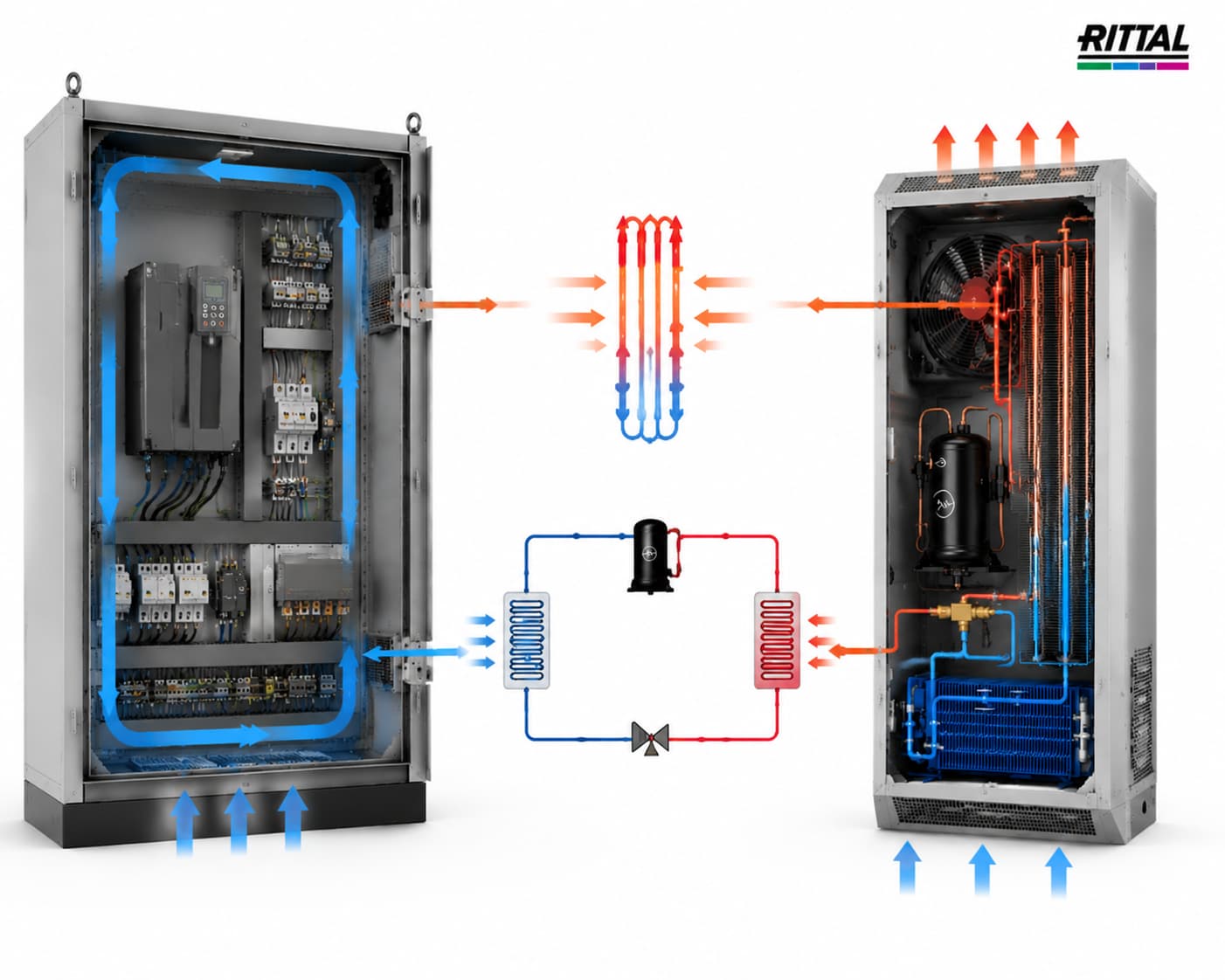
The heat-pipe circuit transfers heat from the enclosure without using the compressor when the temperature relationship between the cabinet and ambient environment permits passive heat removal. When passive cooling is insufficient, the active refrigerant circuit supplies additional cooling.
Rittal describes the two circuits as operating separately or in tandem according to the temperature difference and cooling demand. The active circuit uses inverter-controlled components to deliver demand-based output rather than relying only on fixed-speed compressor switching.
Intelligent cooling control
The controller evaluates cabinet temperature and adjusts operation to maintain the selected condition. Instead of treating cooling as a simple start/stop function, it coordinates the passive and active cooling mechanisms.
The control strategy can:
- Use passive heat transfer when operating conditions make it effective
- Add active refrigeration when more cooling is required
- Adjust compressor and fan operation to thermal demand
- Reduce unnecessary full-output operation
- Maintain a more consistent internal temperature
Dynamic cooling adjustment
The thermal load in a cabinet changes as motors accelerate, drives produce torque, processors perform work, and machine modules enter or leave operation.
Inverter control allows the active cooling circuit to respond to these changes. The objective is not to run continuously at maximum capacity. It is to provide the cooling output needed to control cabinet temperature under the current condition.
This makes the technology particularly relevant to machines with variable duty cycles.
Energy management
Energy savings come from two main mechanisms.
First, the heat pipe can remove heat without compressor operation when the required temperature gradient is available. Second, speed-controlled components can operate at partial output when full active cooling is unnecessary.
Rittal reports average energy savings for specified Blue e+ product families, but those figures should not be treated as a guaranteed result for every installation. Actual savings depend on heat load, setpoint, ambient temperature profile, operating hours, unit selection, cabinet construction, and the efficiency of the system used for comparison. Application-specific energy analysis remains necessary.
Temperature monitoring
Blue e+ products incorporate electronic control and communication functions intended to support operation, parameter access, diagnostics, and integration with higher-level monitoring systems. Available functions vary by model and accessory configuration.
Rittal’s documentation describes touch-display operation, intelligent interfaces, NFC-based access on supported units, and an IoT interface for connecting cooling devices and environmental sensors to supervisory systems.
These capabilities can make cabinet temperature and cooling-unit status visible to maintenance or energy-management systems. They do not replace correct engineering, but they improve the information available for commissioning and maintenance.
Key Advantages of Blue e+ Cooling Technology
Energy Efficiency
The most important efficiency improvement is the ability to avoid unnecessary compressor work.
When the cabinet-to-ambient temperature relationship supports passive heat transfer, the heat-pipe circuit can carry part or all of the load. When active refrigeration is required, the inverter-driven system can adjust output rather than repeatedly operating at a fixed maximum rate.
This approach can reduce energy waste associated with:
- Full-speed operation at partial thermal load
- Repeated compressor starts and stops
- Cooling output that substantially exceeds current demand
- Poor control during standby or reduced production
- Oversized units operating in short cycles
Energy performance must still be evaluated at system level. A low setpoint, obstructed airflow, contaminated heat exchanger, excessive cabinet leakage, or incorrect unit size can reduce the expected benefit.
Stable Temperature Control
Demand-based control can produce a narrower temperature range than basic on/off operation, particularly when the cabinet heat load changes frequently.
Stable conditions help protect:
- PLCs, including processors and densely arranged I/O modules
- Drives, whose losses change with motor load and switching conditions
- Industrial PCs, storage devices, displays, and communication interfaces
- Power supplies, especially components sensitive to prolonged high temperature
- Electronic components, including capacitors, relays, safety modules, and network equipment
Stable temperature does not mean that every device in the cabinet will have the same temperature. Internal air distribution remains important. Engineers must preserve clear airflow paths and prevent hot discharge air from one component from entering another component’s cooling inlet.
Reduced Maintenance Requirements
Blue e+ technology can reduce certain maintenance pressures, but it does not make the cooling system maintenance-free.
Speed-controlled operation can reduce unnecessary mechanical duty, while diagnostic and monitoring functions can help technicians identify operating conditions and system messages more efficiently. Remote visibility may also reduce the need for routine physical inspection solely to check temperature or basic unit status.
Potential maintenance benefits include:
- Earlier recognition of abnormal cabinet temperatures
- More targeted service based on operating information
- Faster access to diagnostic messages
- Easier parameter verification
- Reduced troubleshooting time for intermittent thermal faults
- Less severe fixed-speed cycling under part-load conditions
Normal service tasks remain necessary. External heat-transfer surfaces must stay clean, condensate management must be inspected where applicable, airflow must remain unobstructed, and alarms must be investigated. Maintenance intervals should be based on the installation environment and the manufacturer’s instructions.
Improved Equipment Reliability
A correctly selected cooling system reduces the likelihood that components will operate at damaging temperatures. It also improves the repeatability of the cabinet environment as production conditions change.
The reliability value appears in two areas:
- Reduced component failure risk: Lower and more stable temperatures can reduce thermal stress on sensitive electronic and power components.
- Reduced downtime risk: Monitoring and diagnostics can provide earlier warning of deteriorating cooling performance before it results in a process interruption.
Cooling does not compensate for poor panel design. Reliability still depends on correct component spacing, conductor sizing, protection coordination, airflow management, grounding, contamination control, and preventive maintenance.
Blue e+ Cooling Technology vs Traditional Cooling Solutions
| Evaluation Field |
Ventilation Cooling |
Conventional Cabinet Air Conditioner |
Blue e+ Cooling Technology |
| Cooling Control |
Primarily based on airflow; strongly dependent on ambient temperature |
Commonly uses fixed-speed, on/off compressor control |
Coordinates passive heat-pipe cooling with demand-based, inverter-controlled active cooling |
| Energy Efficiency |
Low electrical input, but only suitable when ambient conditions allow effective heat removal |
Can consume unnecessary energy at partial load |
Reduces compressor use when passive cooling is available and adjusts active output to demand |
| Temperature Stability |
Limited control; cabinet temperature follows ambient conditions |
Suitable for below-ambient cooling, but cycling may create a wider temperature band |
Designed for more continuous, load-responsive temperature control |
| Maintenance |
Filters may require frequent inspection or replacement in contaminated environments |
Requires heat-exchanger cleaning, condensate checks, and refrigeration-system maintenance |
Still requires scheduled maintenance, but monitoring and diagnostics can support more targeted service |
| Application Adaptability |
Appropriate for clean, cool environments and moderate heat loads |
Suitable for closed-loop cooling and relatively stable applications |
Well suited to variable loads, higher heat density, energy-sensitive projects, and connected maintenance systems |
The table does not establish a universal preference. A well-designed ventilation system may be more economical for a clean, air-conditioned room with a low cabinet heat load. An air/water heat exchanger may be preferable where plant cooling water is available or where rejecting heat into the room is unacceptable.
Blue e+ becomes more relevant when the application combines variable load, high availability requirements, significant operating hours, and a need for controlled closed-loop cooling.
Applications of Blue e+ Cooling Technology
PLC Control Cabinets
PLC control cabinets are used in manufacturing lines, process skids, conveyor systems, packaging machines, and material-handling equipment.
Their heat load may include the PLC processor, I/O modules, safety equipment, power supplies, managed switches, relays, and interface devices. Dense mounting and extensive wiring can obstruct natural convection.
The cooling value is primarily temperature stability and closed-loop separation from the factory environment. This helps maintain suitable conditions for control electronics while intelligent monitoring provides useful information for troubleshooting.
Machine Automation Systems
Machine automation cabinets frequently contain servo drives, VFDs, motion controllers, braking components, industrial PCs, and high-capacity power supplies.
Thermal load varies considerably during the machine cycle. A drive system may produce little heat during standby and substantially more during acceleration or continuous production.
Dynamic cooling is useful in this scenario because the system can respond to changing demand. The engineer can size for the maximum credible operating condition without assuming that full cooling output must be used throughout every shift.
Industrial Communication Cabinets
Industrial communication cabinets may house Ethernet switches, routers, gateways, protocol converters, fiber equipment, remote I/O, and industrial computers.
Although each device may have a modest individual power loss, the equipment often operates continuously. Compact cabinets can also have limited internal air volume and little space for natural convection.
Maintaining a controlled temperature supports communication reliability and may reduce the risk of temperature-related network interruptions. Status integration can be especially valuable because these cabinets may be distributed across a large facility.
Factory Automation Equipment
Factory automation equipment includes robotic cells, automated assembly lines, inspection systems, warehouse equipment, and production machines operating in varied environments.
Cabinets may be exposed to dust, oil mist, humidity, high room temperature, or heat released by nearby machinery. They may also run for long shifts, making energy consumption and availability important evaluation factors.
Industrial Cabinet Cooling Application Example
A closed-loop industrial cabinet cooling solution prevents the direct exchange of contaminated external air with the cabinet’s internal circuit. Hybrid, demand-controlled operation can then manage heat according to the machine’s actual production state.
A machine builder designed a compact automation cabinet containing PLC modules, servo drives, VFDs, industrial PC, and power supplies.
During continuous operation, the cabinet experienced increased internal temperature due to high component density and variable production loads.
The engineering evaluation included:
- Internal heat load calculation
- Ambient temperature analysis
- Cabinet protection requirements
- Cooling capacity verification
After selecting a suitable closed-loop cooling solution with intelligent temperature control, the cabinet achieved more stable operating conditions and improved thermal reliability.
How to Select the Right Industrial Cabinet Cooling Solution
Blue e+ Cooling Technology should be selected through the same disciplined engineering process used for any other cabinet climate-control system.
1. Cabinet heat load calculation
Begin by calculating the internal power loss, not the total connected electrical load.
Collect heat-dissipation data for:
- PLC and I/O equipment
- VFDs and servo drives
- Power supplies
- Industrial PCs and displays
- Transformers
- Communication modules and switches
- Contactors, relays, and protective devices
- Braking resistors located inside the enclosure
- Other continuously or intermittently energized equipment
Use manufacturer loss data at the expected operating point whenever possible. For variable loads, define normal, maximum, and standby cases. Applying every component’s maximum loss simultaneously may produce excessive oversizing if that operating state cannot occur, but ignoring credible peak conditions creates undercapacity risk.
The required cooling duty should consider:
Q required = Q internal losses + Q heat entering through enclosure - Q natural heat dissipation
The enclosure’s surface area, material, installation position, neighboring cabinets, ambient temperature, and target internal temperature affect the result. Rittal provides the RiTherm calculation tool for evaluating enclosure geometry, component heat loss, and ambient conditions.
2. Ambient environment evaluation
Record the real installation conditions rather than relying only on a general factory temperature.
Evaluate:
- Maximum and minimum ambient temperature
- Daily and seasonal temperature variation
- Dust concentration and particle type
- Oil mist, fibers, conductive dust, and corrosive substances
- Relative humidity and condensation risk
- Indoor or outdoor installation
- Direct solar radiation
- Elevation and any resulting performance derating
- Heat discharged by nearby machines or cooling units
- Available room ventilation
- Washdown or hygiene requirements
Remember that an enclosure air conditioner transfers cabinet heat into the surrounding space. In a small machine room, multiple cooling units can raise ambient temperature and reduce their own available cooling capacity. The facility-level heat rejection path must therefore be checked.
3. Protection requirements
The cooling method must be compatible with the required enclosure protection.
Consider:
- Required IP or NEMA rating
- Separation of internal and external airflow
- Resistance to dust, water, oil, or chemicals
- Indoor or outdoor certification
- Material and corrosion-resistance requirements
- Hygienic design requirements
- Electrical supply, frequency, approvals, and target markets
- Acceptable condensate-management method
Ventilation creates an open air path and can reduce practical protection against contamination. Closed-loop cooling better preserves separation, but only when the cooling unit, mounting arrangement, seals, and enclosure are correctly specified.
For machines shipped internationally, supply-voltage compatibility and regional approvals should be reviewed at the beginning of the project rather than after mechanical design is complete.
4. Cooling capacity selection
Select capacity using the manufacturer’s performance data at the project’s actual internal and external temperatures. A nominal rating stated at one test condition may not represent the capacity available on a hot factory floor.
A sound selection process should:
- Define the maximum acceptable cabinet temperature.
- Determine the maximum credible ambient temperature.
- Calculate internal heat loss for each operating state.
- Use performance curves or approved selection software.
- Apply documented derating factors.
- Include a justified engineering reserve.
- Verify the cooling system’s controllable operating range.
- Check internal and external airflow clearances.
- Confirm condensate behavior and drainage requirements.
- Compare annual energy and maintenance implications.
Avoid adding a large arbitrary safety margin. Excessive oversizing increases purchase cost and may produce poor control behavior. A modest documented reserve for uncertainty, aging, and planned expansion is more defensible.
Rittal’s technical cooling guidance also advises considering enclosure protection, ambient pollution, neighboring heat sources, site ventilation, and installation arrangement during selection.
Relevant Industrial Standards
Industrial cabinet cooling selection should also consider applicable electrical and enclosure standards, including:
- IEC 60204-1 — Safety of machinery electrical equipment
- IEC 60529 — Degrees of protection provided by enclosures (IP Code)
Future Trends in Industrial Cabinet Thermal Management
Industry 4.0 and smart manufacturing are changing cabinet cooling from a largely independent utility into a connected machine subsystem.
Connected operating data
Temperature, alarms, running states, and cooling-system information can be transmitted to local control or supervisory platforms. This makes it possible to compare thermal behavior with production state, machine load, and ambient conditions.
Engineers can use this data to determine whether a temperature increase results from higher production demand, restricted airflow, contamination, an open cabinet door, or degrading cooling performance.
Intelligent maintenance
Future maintenance strategies will rely less on fixed inspection intervals alone. Condition data can help maintenance teams prioritize equipment showing abnormal temperature or operating patterns.
The goal is not to eliminate physical inspection. It is to make intervention more targeted and to recognize developing thermal problems earlier.
Energy efficiency as a system requirement
Electrical cabinet cooling operates for many hours and may be installed across dozens or hundreds of enclosures. Even moderate efficiency improvements per cabinet can influence facility energy use.
Lifecycle evaluation will increasingly include:
- Part-load efficiency
- Annual ambient-temperature profile
- Machine duty cycle
- Heat rejected into production rooms
- Maintenance labor
- Refrigerant characteristics
- Cooling-system communication
- Expected service life
Integration with digital engineering
Thermal design is moving earlier in the engineering workflow. Cabinet geometry, component losses, mounting layouts, and climate-control requirements can be evaluated before physical assembly.
This supports better cooling-unit sizing, more effective component placement, and clearer documentation for machine builders, system integrators, and end users.
Conclusion
Modern automation cabinets contain more electronics, higher component density, and increasingly variable thermal loads. PLCs, VFDs, industrial PCs, power supplies, and communication modules all depend on an environment that remains within their permitted operating conditions.
Ventilation remains appropriate for low heat loads in clean, cool environments. Conventional refrigeration-based cooling provides closed-loop, below-ambient operation but may be less efficient when fixed-speed equipment serves a variable load.
Blue e+ Cooling Technology addresses this engineering gap by combining passive heat-pipe operation, inverter-controlled active cooling, intelligent temperature control, and connected monitoring capabilities. Its practical value is strongest where cabinet loads vary, production availability matters, and energy consumption must be evaluated over the machine lifecycle.
The technology should not be selected on its name alone. Engineers should calculate the cabinet heat load, assess the complete ambient environment, establish protection requirements, and verify available cooling capacity at the actual operating condition.
When those steps are completed correctly, Blue e+ can form part of a reliable and energy-conscious industrial cabinet cooling strategy. Machine builders, panel builders, and procurement teams should compare it with ventilation, conventional air conditioning, air/water heat exchangers, and other industrial enclosure cooling solutions according to the needs of the specific installation.
However, choosing the right cooling technology is only part of effective cabinet thermal management. Incorrect heat load calculation, unsuitable cooling selection, and poor installation practices can still lead to temperature problems and reduced equipment reliability.
A reliable industrial cabinet cooling system requires proper evaluation of heat generation, operating conditions, enclosure requirements, and cooling performance.
In the next guide:
Common Cabinet Cooling Mistakes
we will explain the most common errors in cabinet cooling design and how engineers can avoid temperature instability, unnecessary energy consumption, and reduced equipment reliability.
FAQ
Q1: What is Blue e+ Cooling Technology?
A: Blue e+ Cooling Technology is a hybrid enclosure-cooling approach developed by Rittal. It combines a passive heat-pipe circuit with an active, inverter-controlled refrigerant circuit. The two circuits operate according to cabinet temperature, ambient conditions, and cooling demand.
Q2: How does Blue e+ differ from a conventional control cabinet air conditioner?
A: A conventional unit commonly regulates cooling through fixed-speed compressor cycling. Blue e+ can use passive heat transfer when conditions permit and vary the output of its active circuit. This supports demand-based operation and more stable temperature control.
Q3: Can Blue e+ cooling be used in dusty industrial environments?
A: A closed-loop cooling unit separates internal cabinet air from external air, which is useful in dusty environments. However, the enclosure rating, cooling-unit rating, seals, mounting method, heat-exchanger maintenance, and specific type of contamination must all be evaluated.
Q4: How should engineers calculate the required cooling capacity?
A: Calculate the heat losses of the installed components at their expected operating points, then consider enclosure geometry, ambient temperature, desired internal temperature, installat