For engineers comparing enclosure cooling options, thermoelectric cooling should not be evaluated as a general-purpose substitute for compressor air conditioners. It is a solid-state cooling method with clear strengths and clear limits. In industrial enclosures, control cabinets, telecom systems, and compact automation panels, a thermoelectric cooler can be useful when the heat load is moderate, space is limited, and low-maintenance operation is more important than maximum energy efficiency.
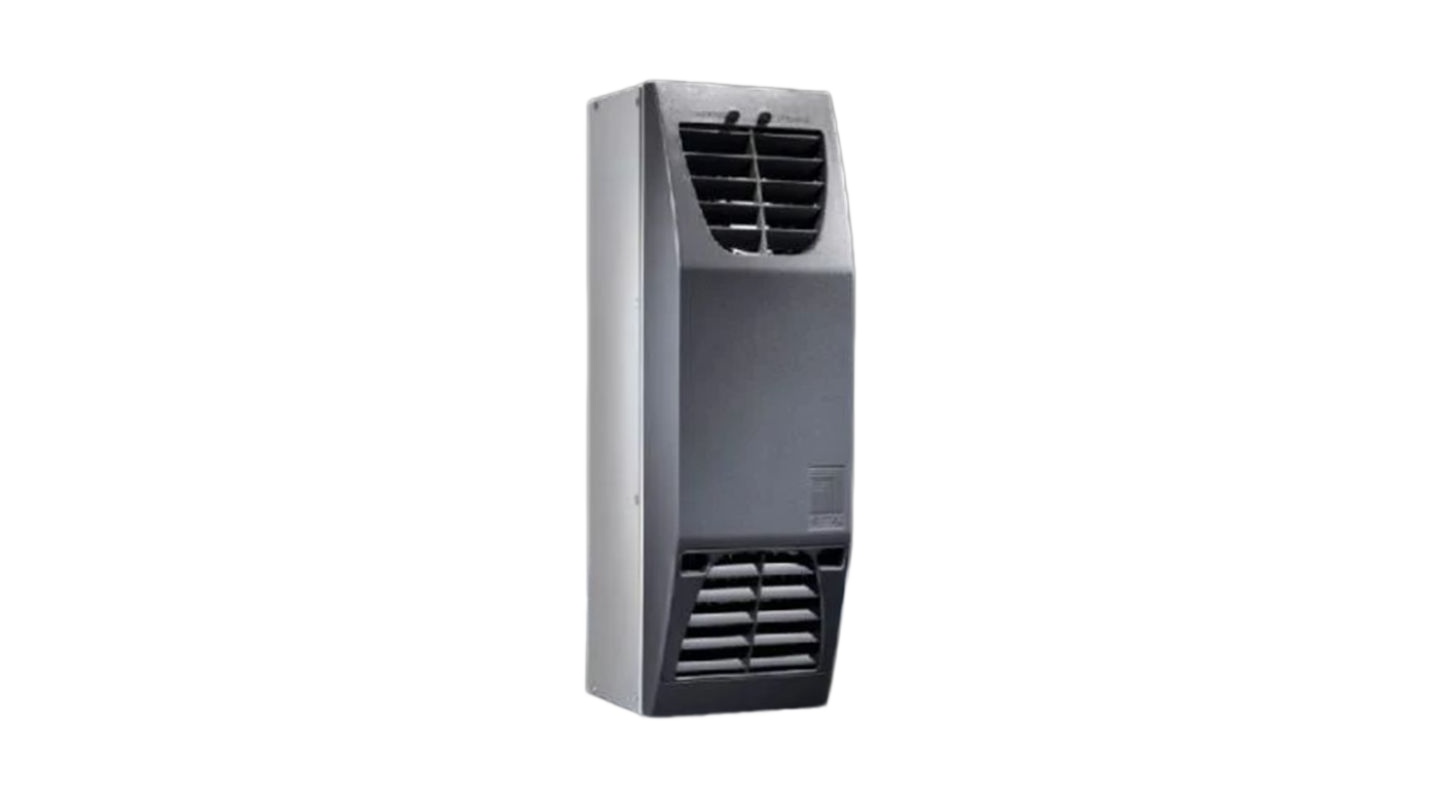
For example, a Rittal thermoelectric cooler should be selected by the same engineering logic as any industrial cooling unit: heat load, ambient temperature, airflow path, and required cabinet temperature must all be verified.
This article answers practical questions such as what is thermoelectric cooling, how does thermoelectric cooling work, and when a Peltier cooling system should or should not be specified for industrial thermal management.
In industrial cabinets, thermal management is not optional when internal heat generation exceeds passive enclosure dissipation. Without proper cooling, PLCs, power supplies, relays, communication devices, and drives may experience derating, nuisance trips, shortened service life, or unplanned downtime. This is why thermoelectric cooling must be evaluated as a risk-control decision, not only as a product feature.
1. System Positioning: A Thermoelectric Cooler Is for Low-to-Moderate Heat Loads
A thermoelectric cooler, also called a TEC cooling device, is best positioned as a compact enclosure cooling solution for small to medium heat loads. In practical enclosure cooling, TEC cooling is typically more suitable for low heat load spot cooling, often in the <100–200 W class, depending on module design, heat sink capacity, airflow, ambient temperature, and required temperature difference. This should be treated as a selection guideline, not a universal rating. It is often used where conventional compressor systems are too large, where refrigerant-based equipment is undesirable, or where the cabinet must remain sealed against dust, humidity, or contaminants.
From an engineering standpoint, what is a thermoelectric cooler?
It is a solid-state heat pump that moves heat from the inside of an enclosure to the outside environment using DC power. That makes thermoelectric coolers useful in:
- Industrial control cabinet cooling
- Sealed automation enclosures
- Telecom and communication cabinets
- Remote monitoring systems
- Instrumentation boxes
- Compact electrical cabinets with moderate heat dissipation
The selection constraint is direct: thermoelectric cooling is not a high-capacity cooling platform. If the cabinet contains large drives, transformers, dense power electronics, or continuous high heat generation, a thermoelectric enclosure cooler will usually not provide enough thermal margin.
2. Working Principle: Focus on Heat Transfer, Not Textbook Theory
For engineers asking how do thermoelectric coolers work or thermoelectric cooler how it works, the practical answer is simple: a TEC module uses the Peltier effect to move heat from one side of the module to the other. One side becomes the cold side, facing the enclosure interior. The other becomes the hot side, facing ambient air.Thermoelectric cooling is a differential cooling system. Its useful capacity depends on the temperature difference between the cold side and the hot side. As ΔT increases, available cooling capacity decreases.
The important engineering point is that the system does not destroy heat. It transfers heat. The hot side must reject both the enclosure heat load and the electrical input power.
The heat balance is:
Heat rejected at hot side = heat removed from enclosure + input power
This is the key thermodynamic constraint behind every thermoelectric cooling system. If a unit removes 100 W from a cabinet and consumes 80 W of electrical power, the hot side must reject about 180 W. If the heat sink or airflow path cannot handle that total heat, cooling performance drops quickly.
This is also why questions like how does electric cooling work or what is TEC cooling need an engineering answer, not a generic one. The performance depends less on the module alone and more on the complete thermal path.
3. Performance Constraints: COP, Heat Load, and Temperature Difference Define the Limit
Compared with compressor-based cooling, thermoelectric cooling normally has a lower coefficient of performance. This is why searches such as thermoelectric cooler vs compressor or thermoelectric vs compressor matter during product selection.
The engineering implication is not that one technology is always better. It means each technology has a different operating envelope.The main limitations are efficiency, ambient temperature sensitivity, and heat rejection dependency. TEC systems usually have lower COP than compressor-based cabinet air conditioners. A module may show a high maximum ΔT under ideal conditions, but real system-level ΔT is lower after heat load, heat sink resistance, airflow, and enclosure losses are included. In many industrial designs, a module-level ΔT around the 40°C class should not be interpreted as cabinet-level cooling capability.
A thermoelectric cooling unit is generally suitable when:
- Heat load is low to moderate
- Cabinet volume is limited
- Maintenance access is difficult
- Refrigerants are not preferred
- Sealed enclosure cooling is required
- Vibration and mechanical complexity should be minimized
A compressor system is usually more suitable when:
- Heat load is high
- Ambient temperature is severe
- Continuous cooling demand is large
- Energy efficiency is a primary design factor
- Large control cabinets require high cooling capacity
If the heat load is high or the required ΔT is large, compressor cabinet air conditioning is usually the stronger option. If ambient air is cooler than the cabinet target temperature and enclosure sealing is needed, an air-to-air heat exchanger may be appropriate. If the site air is clean and cooler than the cabinet interior, a filter fan system may be sufficient. For dense power electronics, liquid cooling or cabinet redesign may be required.
Terms such as thermoelectric refrigeration, thermoelectric refrigeration system, and what is thermoelectric refrigeration are often used in search behavior, but in industrial enclosures the more accurate selection question is whether the device can maintain the required cabinet temperature under real ambient conditions.
4. System Design Considerations: The Hot Side Often Determines Success or Failure
A thermoelectric cooling technology decision is never just a module decision. It is a system-level industrial thermal management decision.
The hot side must have enough heat sink area, airflow, clearance, and ambient exposure to reject heat. If the hot side is mounted in a stagnant air pocket, blocked by adjacent equipment, or exposed to high ambient temperature, the cold side temperature will rise and the enclosure will lose cooling capacity.
Key design checks include:
- Total internal heat load in watts
- Maximum ambient temperature
- Required internal cabinet temperature
- Hot-side airflow clearance
- Heat sink contamination risk
- Enclosure sealing level
- DC power supply capacity
- Condensation risk on the cold side
- Duty cycle and continuous operation requirements
This is where many TEC cooling applications fail in practice. A Rittal thermoelectric cooling unit can be correctly specified on paper but still underperform if the heat sink, fan, airflow path, or cabinet location prevents stable heat rejection.
For this reason, a thermoelectric chiller, thermo electric chiller, or thermoelectric chillers solution should not be selected only by nominal capacity. Engineers need to verify heat load, ambient temperature, and hot-side thermal resistance before approving the design.
5. Application Suitability Model: When to Use and When to Reject Thermoelectric Cooling
The practical applications of thermoelectric coolers TEC are strongest where the thermal load is predictable and moderate. In enclosure cooling, this often includes electronics protection, small cabinet cooling, telecom cabinet stabilization, and local cooling for sensitive components.
Use thermoelectric cooling when:
- The enclosure has a modest heat load
- Space is limited
- Maintenance access is difficult
- The cabinet must remain sealed
- Compressor maintenance is undesirable
- Hot-side airflow can be guaranteed
- The system needs compact, solid-state cooling
Do not use thermoelectric cooling when:
- The system has a high continuous heat load
- The cabinet contains high-power drives or transformers
- Ambient temperature is extreme
- Hot-side airflow is restricted
- Cooling margin is small or uncertain
- Efficiency is more important than compactness
- The cabinet requires large-scale refrigeration cooling TEC capacity
For procurement teams, this distinction matters because a Rittal thermoelectric cooler should not be purchased only by product category or nominal cooling capacity. The buying decision should be checked against actual enclosure heat load, maximum ambient temperature, required internal cabinet temperature, available mounting space, and hot-side airflow conditions.
When evaluating a Rittal thermoelectric cooling unit, procurement engineers should confirm rated cooling capacity under realistic ambient conditions, power consumption, enclosure compatibility, maintenance requirements, and installation constraints. The decision should be based on verified thermal performance, not cabinet size alone.
Thermoelectric cooling can be a reliable option for enclosure cooling when the application falls within its proper engineering envelope. For high heat load systems, restricted airflow installations, or cabinets with limited temperature margin, procurement should reject the technology early and specify a higher-capacity industrial thermal management solution.
Need pricing or technical assistance? Contact us to discuss your enclosure cooling requirements.