Monday morning, humid workshop, cabinet door opens, and there is a thin layer of moisture on the inside metal plate. A few minutes later, the drive trips or the control power supply starts acting up. This is the kind of failure that looks small on paper and turns expensive in production. In most cases, the problem is not simply "not enough cooling." The real problem is that the cooling method did not match the site condition.
If the enclosure is exposed to high humidity, dust, oil mist, or frequent load swings, then cooling must be selected as part of the cabinet design, not as an afterthought. That is where integrated enclosure cooling earns its place: it helps the customer avoid condensation, clogged airflow paths, and unnecessary maintenance hours.
What the field actually needs
Most customers are not buying cooling for the sake of cooling. They are trying to prevent three concrete problems: condensation, thermal overload, and repeated maintenance. Those are the issues that raise failure rate and maintenance hours.
The physics is simple. If the cabinet surface drops below the dew point, moisture condenses. If dust or oil mist blocks the air path, heat transfer drops. If load rises and airflow stays fixed, hot spots appear first at the drive, power supply, and upper part of the enclosure.
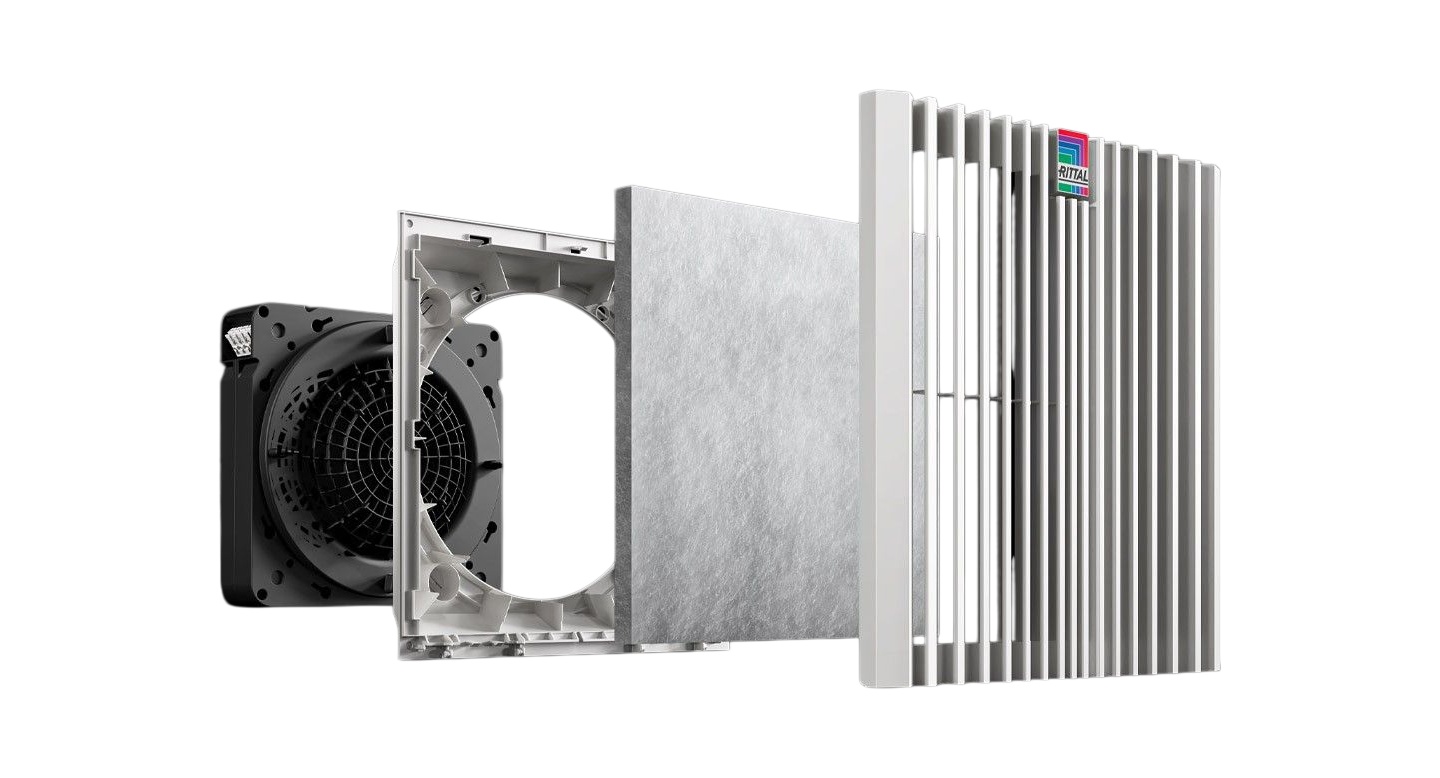
Cabinet cooling selection for dusty sites: dust does not just dirty the cabinet, it destroys airflow
Cement plants, stone processing lines, wood shops, and other dusty workshops usually kill cooling performance in a slow but very predictable way. The filter mat loads up, airflow drops, internal temperature rises, and the drive starts cycling in and out of thermal protection.
That is why many failures are not "fan failures" in the strict sense. The fan is still spinning. The problem is that the air path is already choked.
What to do on site:
- Use fan filter units only when the dust load is light to moderate and maintenance access is realistic.
- For continuous heavy dust, move to a cabinet air conditioner or air-to-air heat exchanger instead of depending on open-air intake.
- Do not wait for an alarm. Filter mats should be checked by contamination level, not by calendar memory.
- If the fan filter unit is the chosen solution, leave airflow margin in the design. Do not size it right at the edge.
Suwi distributor's Blue e Filter Fan product page explicitly mentions tool-free assembly and maintenance, which is useful only if the field actually keeps up with filter service. In other words: easy maintenance is a feature, but it still needs a maintenance plan.
Industrial fan filter maintenance: why oil mist and tight layout turn service into a time sink
In CNC workshops, oil mist is often worse than dust. Oil film sticks to the filter mat and heat sink, and then dust bonds to the oil. After that, cleaning becomes slow and thermal performance keeps sliding down.
Tight installation space creates a second problem. If the cabinet is pushed against a wall or surrounded by other equipment, hot exhaust air can recirculate back into the same area. The result is a local heat loop around the enclosure. The cooling unit is working, but the cabinet is breathing its own hot air.
What to do on site:
- In oil mist areas, prefer a sealed cabinet air conditioner or air-to-air heat exchanger over an open intake fan solution.
- Keep enough service space around the cabinet so the exhaust path is not blocked.
- Do not stack high-heat devices together. Spread drives, power supplies, and PLC sections so the upper hot spot is not overloaded.
- If a site keeps creating maintenance problems, measure the maintenance hours, not just the temperature curve. That is where the real cost shows up.
Cabinet cooling selection guide: match the cooling method to the site, not the habit
| Site condition |
Main risk |
Recommended approach |
What to check first |
| High humidity |
Condensation on metal surfaces and terminals |
Cabinet air conditioner with proper temperature control |
Dew point, door seal, cable entry, cabinet surface temperature |
| Light to moderate dust |
Filter loading and airflow drop |
Fan filter unit with planned maintenance |
Filter condition, airflow margin, service access |
| Heavy dust |
Fast clogging and hot spots |
Cabinet air conditioner or air-to-air heat exchanger |
Dust load, cleaning interval, enclosure sealing |
| Oil mist |
Sticky buildup on filter and heat transfer surfaces |
Sealed cabinet air conditioner or air-to-air heat exchanger |
Oil concentration, cleaning burden, exhaust recirculation |
| Variable heat load |
Frequent temperature swings and unstable operation |
Speed-controlled cabinet air conditioner or chiller |
Load profile, controller response, allowable temperature fluctuation |
Enclosure condensation: why humid sites fail by moisture, not by headline temperature
This is the classic problem in coastal plants on the Gulf Coast, washdown lines in food processing plants, outdoor electrical rooms in rainy climates, and refrigerated utility spaces with frequent temperature swings. The cabinet may look fine at first, but once the surface temperature falls below the dew point, moisture starts to form on metal parts and terminals.
What to do on site:
- Check the dew point first. If you do not know the dew point, you do not yet know the correct cooling setpoint.
- Do not push the cabinet temperature too low just because the number looks good. Cold surfaces are what trigger condensation.
- Inspect the door seal, cable glands, and cable entry plates before blaming the cooling unit.
- If the enclosure is opened often, choose a solution with temperature control and moisture-aware operation instead of relying on simple ventilation.
This is also where the IP rating matters. The enclosure protection level should be judged according to IEC 60529 , not by the marketing line printed on a product page.
Conclusion
Integrated cooling is becoming more important because it solves more than heat. It reduces complexity, improves serviceability, and supports a more efficient industrial workflow.
If your team is trying to cut downtime and simplify enclosure planning, this is one area where a thoughtful redesign can pay off quickly.