
Get a Free Quote
If you are interested in our products and want to know more details,please leave a message here,we will reply you as soon as we can.

Distribution operations are moving from predominantly manual material flow toward connected combinations of conveyors, intelligent sortation, automated storage and retrieval systems, mobile robots, robotic handling and software-directed control. This transition is visible in current investment plans: according to the 2026 MHI Annual Industry Report, 73% of respondents expect robotics and automation to be adopted within five years. The engineering consequence is not simply “more robots.” It is a larger, more distributed control architecture with more sensors, drives, safety functions, network nodes and electrical loads.
That architecture depends on electrical infrastructure that can keep control equipment powered, protected, connected and thermally stable. A failed power supply, overheated drive or contaminated network switch may stop a conveyor zone, isolate an AS/RS aisle or interrupt a robotic cell. Enclosures, climate control, power distribution and repeatable panel construction therefore belong in the system design—not at the end of procurement. SUWI supports logistics automation projects with industrial enclosures, cabinet climate-control options, power-distribution products, accessories and enclosure modification services.
A warehouse automation system is a chain of decisions and power flow:
Sensors and field devices → PLCs and industrial controllers → drives and motor control → industrial networks → power distribution → conveyors, robots, AS/RS equipment and charging infrastructure
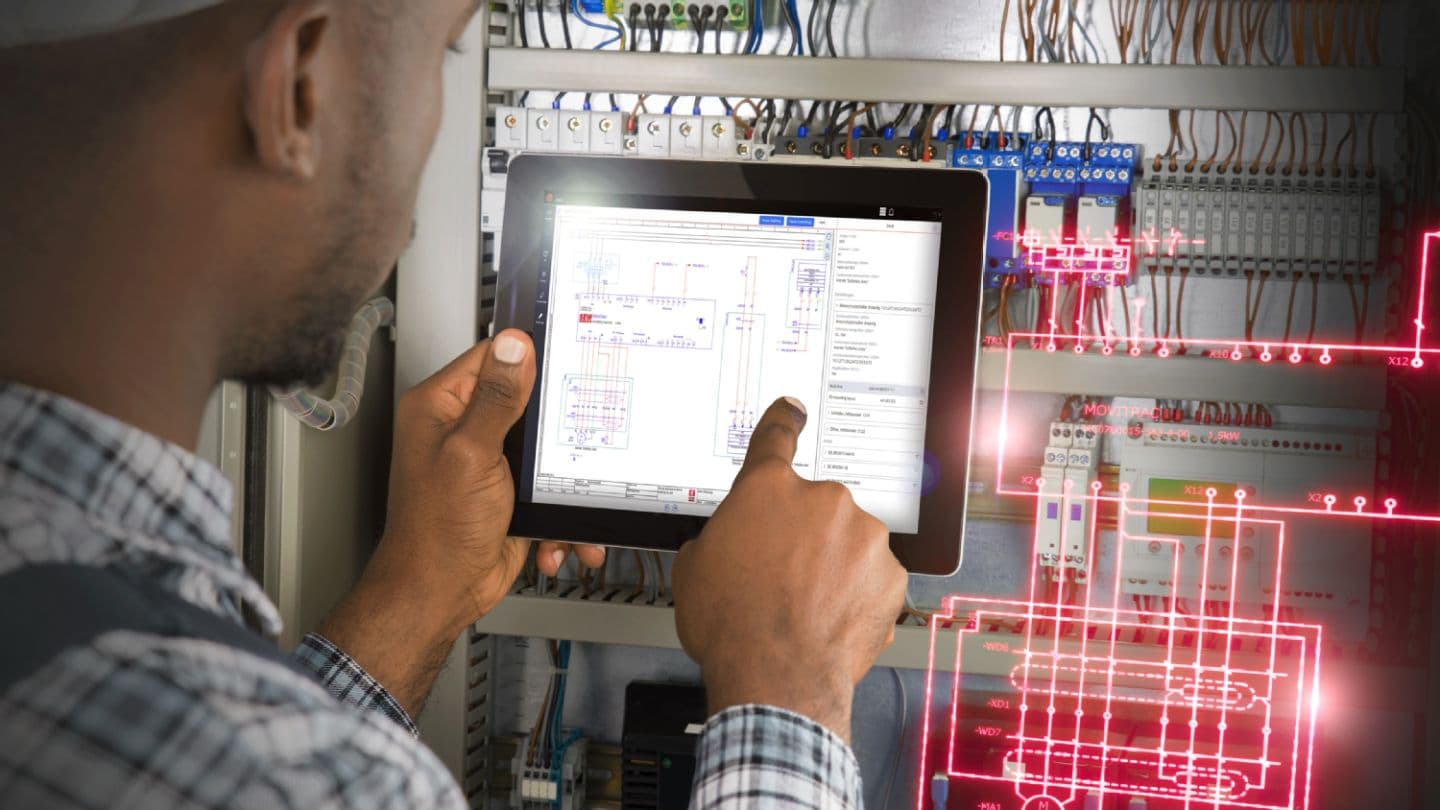
The physical flow may begin with a photoelectric sensor detecting a carton. The control flow continues through remote I/O or a PLC, the warehouse control system assigns a destination, and a drive changes conveyor speed or actuates a diverter. Safety controllers supervise protective devices, while industrial PCs and network switches connect local equipment to higher-level systems.
The enclosure is the controlled operating space around this equipment. It houses combinations of PLCs, VFDs, servo drives, industrial PCs, power supplies, contactors, circuit protection, switchgear, network equipment, I/O and safety devices. Its job is broader than preventing accidental contact. It must support cable segregation, heat removal, bonding, maintenance access and future changes while maintaining the environmental protection required at the installation point.
This is why a warehouse control cabinet should not be selected from dimensions alone. The same component list can require a different enclosure when it moves from a clean electrical room to a dusty conveyor mezzanine, a loading dock, a refrigerated zone or an outdoor yard.
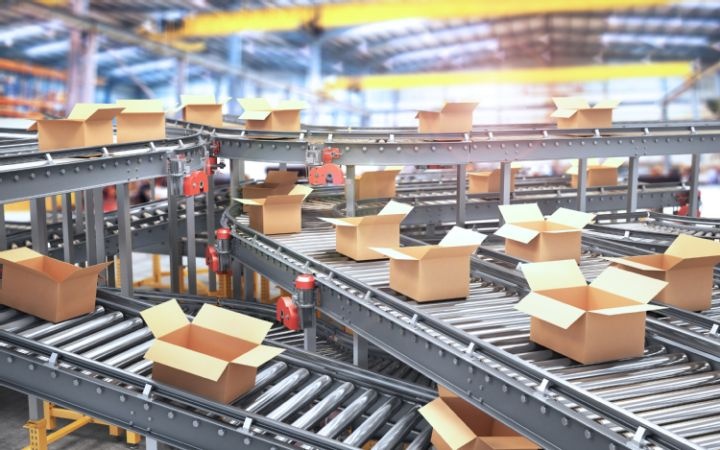
Conveyor and Sortation Systems
Conveyors and sorters move, identify, merge and divert cartons, totes or parcels across many controlled zones. Local wall-mounted enclosures can suit distributed I/O and smaller drive groups; larger sortation sections may need floor-standing panels with clearer separation between control, drive and power equipment. Dust, frequent cable entries and drive heat are the principal enclosure concerns.
Automated Storage and Retrieval Systems
AS/RS equipment coordinates lifts, shuttles, cranes and transfer conveyors with warehouse control software. Its control architecture may concentrate drives, safety devices and communications in high-density cabinets. Floor-standing, bayable enclosures are often appropriate where cable management, service access or planned expansion are important. The resulting component density requires a thermal evaluation.
AGV and AMR Infrastructure
The vehicles are mobile, but their supporting electrical infrastructure is not. Charging stations, traffic-control interfaces and fleet-management equipment still need protected power and communications. The main enclosure questions are location-specific: impact exposure near vehicle routes, dust or rain at docks, charging-equipment heat and separation of power from data.
Robotic Picking and Palletizing
Robot cells combine robot controllers, safety systems, servo equipment, machine vision and operator interfaces. A compact local enclosure may support cell I/O, while drives and controllers may require a floor-standing cabinet. The design must preserve safe access and keep heat-sensitive control hardware away from higher-loss components.
Distribution Center Control Systems
Site-level control connects warehouse control software, industrial PCs, network equipment and interfaces to multiple machine systems. These cabinets may be less exposed than machine-side panels, but network density, cable organization, power quality and heat from continuously operating electronics become more important. IT racks and industrial control enclosures should be chosen for the equipment format and environment rather than treated as interchangeable.
Parcel Handling Systems
Parcel systems combine scanning, weighing, labeling, high-speed conveying and sortation. Numerous field devices create dense cable-entry requirements, while repeated drive groups can create localized heat. A practical architecture may distribute I/O near the process and retain higher-energy equipment in serviceable central cabinets, depending on line topology and the intended maintenance boundary.
Cold-storage rooms and dock automation add special conditions to these applications. Temperature transitions can create condensation risk, while docks may introduce rain, dust and outdoor temperature swings. Those conditions require an environmental assessment at the exact mounting point, including equipment that crosses a thermal boundary.
Protecting Control Equipment Without Overspecifying the Enclosure
Warehouse electrical enclosures may face airborne dust, fibers, accidental contact, cleaning activity, impact from material handling and, at docks or yards, wind-driven precipitation. IEC 60529 classifies degrees of protection provided by enclosures through the IP Code. NEMA enclosure types address additional environmental conditions and are not a one-for-one reverse conversion from IP ratings; NEMA specifically cautions that an IP designation should not simply be converted into a NEMA type.
The practical rule is to match the protection level to the installation environment and applicable code. A higher rating is not automatically a better system. Tighter sealing can restrict natural heat dissipation or rule out open-loop ventilation. Extra protection can also affect cost, access and the choice of cable glands, filters, HMIs and cooling equipment. The completed assembly is only as effective as its doors, seals, entries and fitted accessories, so every cutout and interface must preserve the intended rating.
Managing Heat Inside Automation Control Cabinets
VFDs, power supplies, PLCs, industrial PCs, network switches and other electronics release part of their input power as heat. Higher component density can create hot zones even when the surrounding warehouse air appears acceptable. Ambient temperature is therefore not the same as enclosure internal temperature.
A thermal review should establish:
- heat dissipated by installed devices under realistic duty
- highest and lowest ambient conditions at the mounting location
- maximum acceptable internal temperature based on component documentation
- enclosure material, effective surface area and mounting position
- internal airflow paths and component spacing
- solar or process heat where applicable; and
- whether ambient air may safely enter the enclosure.
These inputs determine whether the cabinet can reject its heat or needs a dedicated climate-control method. The decision process and capacity check are covered in Climate Control for Logistics Control Cabinets below.
Supporting Scalable Power Distribution
An automated distribution center rarely remains electrically static. Additional conveyor zones, sorters, robotic cells, AS/RS modules and charging points can increase feeder count, protection requirements, cabinet space, wiring and maintenance complexity. Expansion planned only at the machine level can leave the upstream distribution architecture undersized or physically congested.
A scalable design reserves appropriate capacity and organizes distribution so that circuits can be identified, isolated and serviced. Modular busbar or distribution systems can be considered when they match the required current, short-circuit rating, certification regime and panel design. Their value is not “modularity” by itself; it is the ability to create a repeatable, documented architecture with clear protection boundaries and controlled expansion.
Designing for Fast Installation and Expansion
Logistics projects can involve many repeated panels and numerous enclosure interfaces: cable glands, connectors, disconnect handles, filter fans, cooling units, HMIs, pushbuttons and mounting points. If cutting, drilling and tapping are deferred to the site, installers must measure each cabinet, control swarf and surface damage, correct drawing discrepancies and reproduce the same work across multiple locations.
Pre-cutting and drilling from approved drawings moves that work into a controlled preparation stage. Cutouts can be coordinated with component templates, cable-entry zones and internal clearances before the enclosure reaches the installation site. SUWI can support project-based hole cutting, drilling, tapping and machining. Final drawings should identify enclosure orientation, datum points, tolerances, hardware, surface-treatment requirements and any rating-critical interfaces.
Maintenance and System Availability
A small cabinet fault can have a large operational boundary. Loss of a local power supply may disable one conveyor zone; a network or safety fault may stop several connected zones; a drive failure can block an AS/RS aisle or robotic cell. Good enclosure design limits diagnosis time and reduces avoidable service risk.
Maintenance-oriented details include readable labels, current schematics, test access, replaceable filters, accessible terminals, spare space that remains usable, and separation of components that should not be serviced together. Door and component layout should support the facility’s hazardous-energy procedures, but enclosure design alone does not establish OSHA compliance. In the United States, OSHA’s general-industry lockout/tagout rule, 29 CFR 1910.147, establishes minimum performance requirements for controlling hazardous energy during servicing and maintenance.
Start with the installation point, not a preferred cabinet series. Identify contaminants, water exposure, corrosion, temperature, impact risk and access restrictions. Then establish the equipment footprint, cable-bend space, segregation needs, heat loss, service clearances and realistic expansion. Confirm required IP or NEMA classification under the applicable project standards, and verify that all fitted accessories preserve the assembly requirement.
Application / Selection Table
| Application | Typical Environment | Main Concern | Suggested Enclosure Type | Cooling Consideration |
|---|---|---|---|---|
| Conveyor Zone Control | Indoor, machine-side, possible dust | Cable entry, distributed I/O, local drives | Compact wall-mounted or small floor-standing enclosure | Natural convection or filtered air may be suitable; calculate heat load when drives are installed |
| Central Sortation Control | Indoor industrial area | Multiple drives, wiring density, service access | Floor-standing or bayable enclosure system may suit | Thermal evaluation and internal airflow review are recommended |
| AS/RS Aisle Control | Indoor, restricted access, high equipment density | Drives, safety control, network continuity, expansion | Floor-standing modular enclosure is often appropriate | Calculate device heat losses and evaluate active cooling where passive heat rejection is insufficient |
| AMR / AGV Charging Support | Indoor or semi-exposed, near vehicle traffic | Power distribution, impact exposure, communications | Wall-mounted, floor-standing or suitably protected enclosure depending on location | Assess equipment heat loss, ambient peaks and separation of sensitive electronics |
| Robotic Picking & Palletizing | Indoor industrial area | Safe access, drive heat, vision and network equipment | Compact local enclosure or floor-standing control cabinet as required | Review drive duty, internal hot spots and ambient conditions |
| Dock & Material Handling Automation | Dock, canopy or outdoor exposure | Rain, dust, impact and temperature variation | Outdoor-rated or suitably protected industrial enclosure can be considered | Environmental control may require heating, cooling or both depending on site conditions |
Cooling should be selected from a heat balance, not from cabinet dimensions alone.
Step 1 — Determine ambient conditions.Use the temperature and contamination conditions at the enclosure, including seasonal peaks, dock exposure, nearby heat sources and cold-zone transitions.
Step 2 — Estimate internal heat dissipation.Sum manufacturer-provided power-loss values for drives, power supplies, transformers, controllers, computers, network equipment and other devices at the expected operating duty. Do not substitute connected load for dissipated heat.
Step 3 — Define the acceptable internal temperature.Use the installed components’ documentation, with attention to the most temperature-sensitive device and any derating rules.
Step 4 — Evaluate enclosure size and installation.Effective heat-dissipating surface depends on whether the cabinet is free-standing, wall-mounted, recessed or bayed. Check obstructions, internal airflow and clearance around the cooling device.
Step 5 — Choose the cooling method. Decide whether the design can use natural convection, filtered ambient air, separated-air heat exchange or active refrigeration. Protection and air quality can eliminate otherwise thermally feasible options.
Step 6 — Select and verify cooling capacity.As a simplified concept:
Required cooling capacity ≈ internal heat load + environmental heat gain (or − heat released through the enclosure).
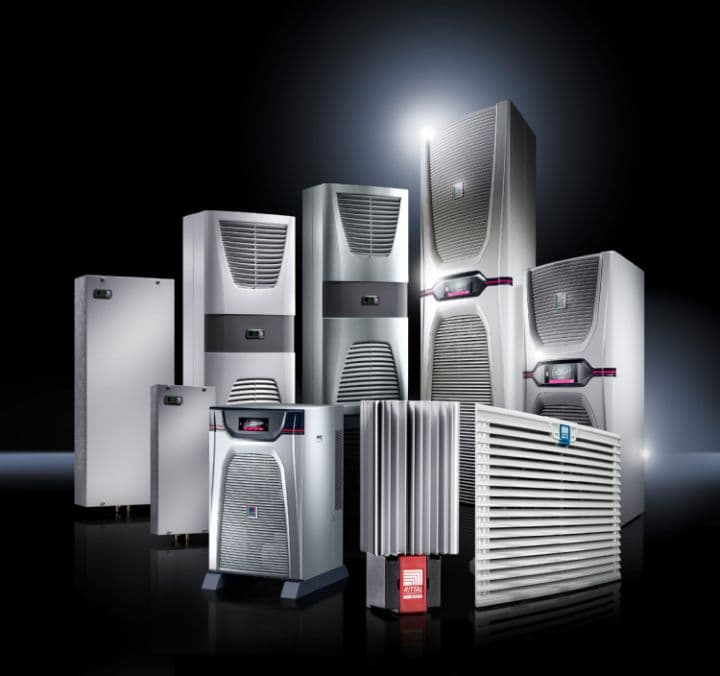
The sign and magnitude of the surface term depend on the internal-to-ambient temperature difference, effective enclosure area, material and installation. Rittal’s official climate-control technical catalogue expresses the same heat-balance approach using installed heat loss and heat emitted or absorbed by the enclosure surface. Final selection should use the cooling-unit manufacturer’s calculation method and performance curves at the actual internal and ambient design temperatures.
Industrial Enclosures
Industrial enclosures provide protected mounting space for automation controls, distribution and networks. The environment, component layout and certification requirements determine the suitable category.
Compact Enclosures
Compact wall-mounted platforms may suit local conveyor controls, remote I/O and smaller machine panels where equipment and cable volume remain manageable. Rittal AX is one candidate for applications requiring a structured wall-mounted platform. The exact model, material and protection rating must be confirmed for the project.
Floor-Standing Enclosures
Floor-standing systems such as Rittal VX25 can be considered where higher component density, cable management or future expansion requires a modular enclosure architecture. Product-specific ratings and configuration must be verified against the manufacturer’s current data.
Stainless Steel Enclosures
Stainless steel is appropriate when moisture, corrosive agents, cleaning practice or hygiene requirements justify it. It is not automatically necessary throughout a logistics facility. A dry indoor electrical room may be better served by a coated carbon-steel enclosure, while a wet dock, cold-store transition or food-logistics washdown zone may require a different material and seal strategy.
Enclosure Climate Control
Where heat load, ambient conditions or air quality rule out passive heat rejection, the project may require ventilation, heat exchange, active cooling or heating. Rittal Blue e and Blue e+ families may be evaluated when active cabinet cooling is required, but selection must be made at a specific model level using calculated load, ambient conditions, voltage, mounting and required approvals.
Power Distribution
Busbar systems, distribution assemblies and monitoring can support repeatable warehouse power architectures when they match the project’s electrical ratings, coordination study, code and panel certification requirements.
Enclosure Accessories
Mounting, cable-entry, bonding, lighting and monitoring accessories should be selected around installation and service needs. Compatibility must be checked with the specific enclosure and fitted equipment.
Enclosure Modification Services
Repeated conveyor zones, robot cells or multi-site deployments may require consistent enclosure interfaces. Pre-cutting, drilling, tapping and machining can translate approved panel layouts into repeatable enclosure preparation before delivery.
Initial cabinet price is only one design input. Installation effort, thermal performance, future expansion, replacement strategy, spare parts, service access and documentation continue to affect the system after commissioning.
Standardization becomes particularly valuable when a facility contains repeated conveyor zones, robotic cells, AS/RS control points and sortation sections. If each uses a different cabinet layout, maintenance teams must learn more variants, stock more parts and navigate inconsistent drawings. Yet making every panel identical can ignore genuine differences in load and environment.
A more useful pattern is a standardized cabinet platform with application-specific modifications. Commonize enclosure families, mounting conventions, labels, cooling interfaces, cable-entry rules and preferred components. Then vary the items that engineering conditions actually require: cabinet size, material, environmental rating, thermal capacity and device population. This approach supports repeatability without pretending that a dry control room and an exposed dock are the same application.
Change control is equally important. When a new drive, switch or power supply is added, update the heat-loss calculation, electrical documentation and spare-capacity record. Physical free space alone does not prove that the cabinet can accept more electrical or thermal load.
SUWI can support system integrators, machine builders, panel builders and engineering teams at the product-matching and enclosure-preparation stages of a logistics automation project. The available scope includes:
- selection support for compact, floor-standing, stainless-steel and application-specific enclosures;
- industrial enclosure and compatible accessory supply;
- comparison and selection support for filter fans, heat exchangers, cooling units and related climate-control components;
- power-distribution products and project-based matching;
- cable-management, mounting, lighting, sealing and other enclosure accessories;
- hole cutting, drilling, tapping and machining from approved drawings; and
- verification of enclosure series, dimensions, part numbers and accessory compatibility before quotation.
SUWI’s portfolio includes Rittal enclosure, climate-control and power-distribution products, but the correct solution begins with the application. Provide the environmental, electrical, thermal and mechanical requirements first; the product family should follow from those constraints.
1Q: What type of enclosure is used for warehouse automation?
A: There is no single warehouse enclosure type. Compact wall-mounted enclosures may support local I/O and conveyor zones; floor-standing or bayable systems often suit larger drive, AS/RS and distribution panels. Choose the material and environmental rating from the installation conditions, then check component space, cabling, heat loss, service access and expansion before selecting a model.
2Q: How do I choose an enclosure for a conveyor control system?
A: Start with the component list, cable count, drive duty and maintenance boundary. A local control point may fit a compact enclosure; a panel serving several motors may need a floor-standing design. Confirm dust and water exposure, ambient temperature, required rating and usable space, then calculate heat dissipation when drives or other higher-loss devices are installed.
3Q: Does an automated warehouse control cabinet need air conditioning?
A: Not necessarily. Low-loss cabinets may use natural convection, while filter fans or heat exchangers can suit appropriate ambient conditions. Active cooling is considered when those methods cannot maintain the required internal temperature. The decision should follow a heat calculation and environmental assessment rather than a general rule for all warehouses.
4Q: How is cooling capacity calculated for an electrical enclosure?
A: Add the heat dissipated by installed equipment and account for heat entering or leaving through the enclosure surface. Then use the cooling-device manufacturer’s performance data at the intended internal and ambient temperatures. Include realistic drive duty and external heat where relevant; cabinet dimensions alone do not determine cooling capacity.
5Q: What IP rating is suitable for warehouse control cabinets?
A: Use the rating justified by the actual exposure and applicable specification. A clean electrical room, dusty mezzanine, wet dock and outdoor yard have different needs. IP and NEMA designations are not reverse-equivalent. Verify the completed assembly, including glands, fans, cooling units, windows and door hardware.
6Q: Can enclosure cutouts be completed before delivery?
A: Yes. SUWI can provide hole cutting, drilling, tapping and machining from approved project drawings. Send the enclosure model and orientation, datum references, cutout dimensions and tolerances, thread details, quantity, and any surface-protection or sealing requirements. The completed assembly must still meet the project’s environmental and certification requirements.
7Q: Are stainless steel enclosures necessary in logistics facilities?
A: Only where the environment supports the choice. Stainless steel can be appropriate for wet, corrosive, washdown or exposed locations, but may add little value in a dry indoor control room. Review humidity, cleaning agents, condensation risk and contaminants together with the gasket, fasteners, cable entries and cooling equipment.
8Q: What information is needed to select a control enclosure?
A: Provide the application, component schedule, dimensions, installation environment, required IP or NEMA type, ambient temperature range, heat-loss estimate, supply voltage, cable-entry plan, quantity, approvals and machining drawings. Include the manufacturer and part number when a product series is already specified so current data and compatibility can be checked.
For enclosure selection or an RFQ, send:
- application and equipment served;
- preferred or maximum enclosure dimensions;
- indoor, outdoor, dock or temperature-controlled installation details;
- required IP rating, NEMA type or other project standard;
- electrical component list and preliminary layout;
- estimated internal heat load and ambient temperature range;
- required supply voltage and frequency for climate-control equipment;
- quantity and delivery location; and
- machining drawings, cutout schedule and tolerances.