
Get a Free Quote
If you are interested in our products and want to know more details,please leave a message here,we will reply you as soon as we can.

Pharmaceutical equipment must support controlled production while electrical systems remain protected, accessible and serviceable. Enclosure selection may need to account for routine wipe-down, washdown, disinfectants, humidity, condensation, particle-control procedures, heat load and restricted installation space.
SUWI helps equipment manufacturers, panel builders, system integrators and plant engineering teams compare industrial enclosures, hygienic-design options, climate-control products, power-distribution components and machining requirements for pharmaceutical applications.
Pharmaceutical facilities do not present one uniform environment. A dry secondary-packaging room, a filling-line auxiliary zone, a washdown area, a utility room and an API process area may require different materials, seals and cooling methods. The correct solution must be based on the installation zone, cleaning procedure, corrosion exposure, heat load and required protection—not on the word “cleanroom” alone.
Compliance note: A stainless-steel enclosure or high IP rating does not by itself establish GMP compliance, FDA approval, sterility or suitability for every cleanroom grade. The pharmaceutical manufacturer remains responsible for equipment qualification, cleaning validation, contamination-control strategy and final site approval.
Start with exposure during production, cleaning, shutdown and maintenance. Review the cleaning agent or SDS, concentration, contact time, water pressure, temperature, spray direction, humidity, condensation, corrosive vapours, particle-control requirements, cable entries and internal heat load. The enclosure body is only one part of the completed assembly; the finish, gasket, hinges, locks, glands, operator devices, cooling equipment and field modifications also require review.
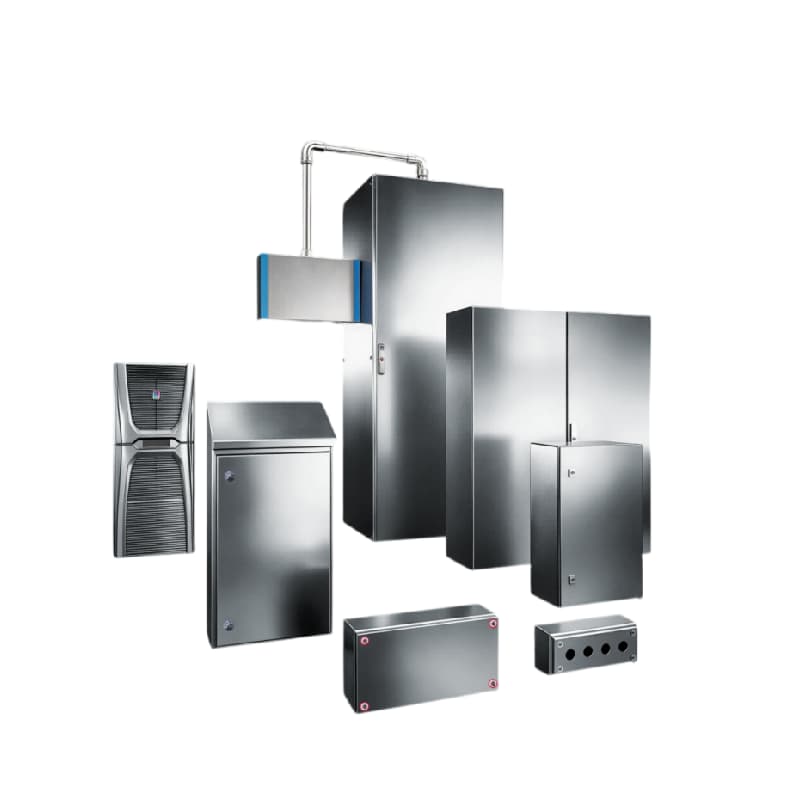
AX stainless-steel compact enclosures may suit local controls, machine-mounted panels and smaller installations where corrosion resistance is required. Confirm whether 304 or 316L is appropriate for the actual exposure.
Hygienic-design enclosures may suit cleaning-critical installations where sloped surfaces, drainage, reduced soil traps and cleanable external hardware form part of the equipment specification.
Modular stainless-steel enclosures may suit larger control systems, bayed suites, dense component layouts and projects requiring configurable internal mounting.
Compare AX stainless-steel enclosures, review Hygienic Design options, or read the VX25 stainless-steel selection guide.
“Stainless steel” is not a complete project specification. Grade selection must be considered with the surface finish, seals, locks, hinges, cable glands, labels, windows and external climate-control equipment. AISI 304 may be suitable for general moisture and compatible routine cleaning, while AISI 316L may be considered where chloride or chemical exposure makes 304 unsuitable. Neither grade is corrosion-proof or universally compatible with every cleaning agent.
| Selection factor | 304 stainless steel | 316L stainless steel |
|---|---|---|
| Typical direction | General moisture, compatible routine cleaning or moderate corrosion exposure | More demanding chloride or chemical exposure where the assessment supports 316L |
| Corrosion review | May be adequate when exposure is controlled; localized corrosion risk still requires review | May improve localized-corrosion resistance, but it is not corrosion-proof |
| Cleaning agents | Check each detergent and disinfectant against the complete enclosure construction | The same compatibility check remains necessary; 316L is not compatible with every agent |
| Data required | Agent or SDS, concentration, temperature, contact time, chloride exposure, rinse and drying method, surface finish, hardware, gasket and exact article number | |
Article-specific examples: Rittal identifies AX 1003.000 as AISI 304 with a grain-400 brushed finish, IP66 and UL 50E Type 4X. AX 1366.000 is identified as AISI 316L with a grain-400 brushed finish, IP66 and UL 50E Type 4X. These ratings apply to the stated article numbers and must not be generalized to every AX configuration or a modified completed assembly.
A standard stainless-steel enclosure can provide corrosion resistance and a documented protection rating, but it is not automatically a hygienic-design enclosure. Cleaning-critical installations may require sloped upper surfaces, fewer external recesses, cleanable lock and hinge details, suitable gasket construction, accessible wall spacing and drainage-oriented mounting.
Rittal HD 4000.012 has a 30° front roof slope, a fitted silicone seal and article-specific IP66/IPX9 ratings. Rittal states that the seal material complies with 21 CFR 177.2600. This describes the specified seal material; it is not FDA certification of the complete enclosure or pharmaceutical installation.
| Area or application | Main concern | Possible direction | Confirm before selection |
|---|---|---|---|
| Secondary packaging equipment | Heat, dust, access, space and cleaning method | Carbon steel or AX stainless steel, depending on exposure | Cleaning procedure, size, heat load, cable entry and rating |
| Filling-line auxiliary equipment | Cleanability, process proximity, wipe-down or washdown | AX stainless steel or hygienic design, subject to zone assessment | Contamination-control strategy, chemistry, mounting and completed rating |
| Utility or technical area | Humidity, condensation, service access and component density | Standard AX or VX25; stainless steel where exposure justifies it | Ambient range, corrosion, expansion, access and cooling |
| Washdown production area | Pressure, temperature, spray direction, chemistry and drainage | Article-specific stainless-steel or HD enclosure | Washdown data, IP/Type target, glands and post-machining sealing |
| API or corrosive process area | Vapours, deposits, splash and aggressive chemicals | 316L or another engineered material direction after corrosion review | Full exposure, area classification, seals, ventilation and approvals |
These are selection directions, not cleanroom-grade approvals. Verify materials, construction and protection ratings against the exact article number and completed assembly. Continue with the Industrial Enclosure Buying Guide for broader construction and rating decisions.
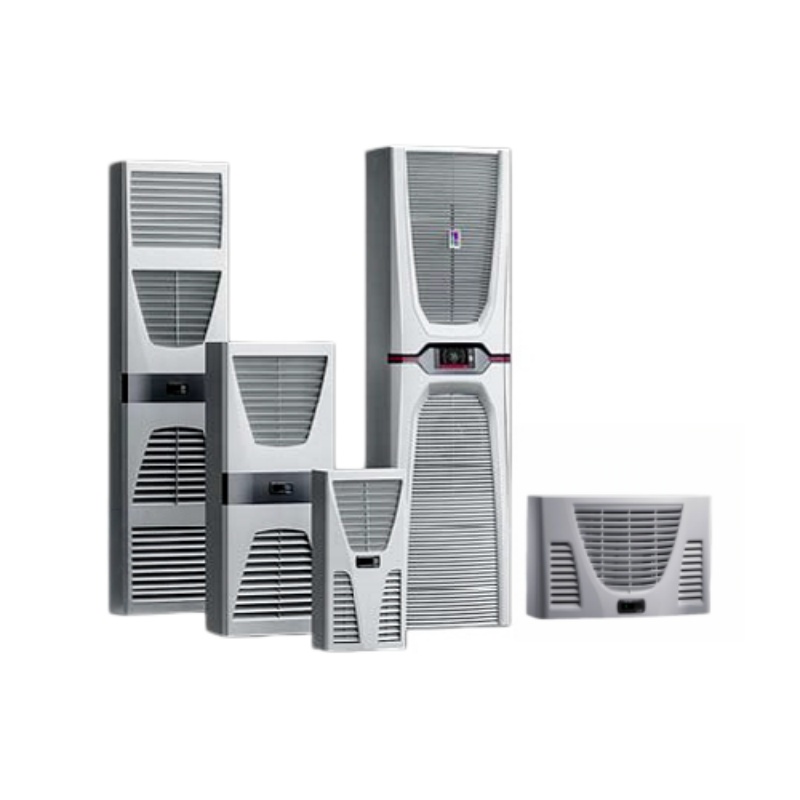
Stainless steel does not solve heat load or condensation by itself. Climate-control planning should begin with component losses, enclosure dimensions, maximum ambient temperature, required internal temperature, humidity, dew point and operating duty.
Open-loop filter fans may be unsuitable where ambient air carries contamination, humidity or corrosive vapours. Closed-loop cooling units or air/water heat exchangers may be considered where the calculated heat load requires active cooling.
Compare climate-control methods or review the stainless-steel wall-mounted cooling unit after defining the heat-load data.
Pharmaceutical equipment often requires cut-outs for HMIs, cable entries, operator devices, windows and cooling equipment. These modifications should be planned before machining because position, edge treatment, sealing and installed hardware can affect cleanability, corrosion resistance and the protection of the completed enclosure.
SUWI provides enclosure cut-outs and panel modifications subject to drawing and project review. See enclosure customization and technical support before submitting the final machining drawing.
Power distribution should be planned together with the enclosure layout rather than added after component placement. Equipment manufacturers and panel builders need enough space for conductors, protective devices, separation, maintenance access and future changes while keeping the panel suitable for required electrical approvals.
Confirm the incoming supply, connected loads, diversity, fault level, protective-device strategy, conductor routing and space required for heat-producing components.
Provide safe access for inspection and replacement. Coordinate the power layout with doors, mounting plates, partitions, cable entries and climate-control airflow.
Review SUWI power-distribution solutions. Final selection must be completed by qualified electrical personnel using the applicable project standard and destination-country requirements.
A request for “a pharmaceutical stainless-steel cabinet” does not provide enough information for defensible selection. Keep the enclosure model, material, rating, accessory list, thermal calculation, drawings, revision status and approval documents connected to the final quoted configuration.
Before quotation, provide:
Review About SUWI and authorization and certificate information. Use authorization statements only within their published scope. Project documents should correspond to the exact quoted article numbers.
This page provides enclosure and panel-selection guidance. It does not certify a pharmaceutical installation or replace the manufacturer’s contamination-control strategy, cleaning validation, electrical design review or site qualification. Product specifications must be checked against the exact article number and current manufacturer documentation.
Choose from the actual exposure, not the industry label. Confirm the agent, concentration, temperature, contact time, chloride exposure, rinse process, hardware, gasket and exact article number.
No. The site must assess material, finish, geometry, seals, external hardware, particle-control requirements, cleaning access, location and completed-assembly rating.
Not automatically. VX25 provides a modular floor-standing architecture, while hygienic design focuses on cleanable external geometry, drainage and installation details. The project may require one characteristic, the other, or a separately reviewed combination.
No. An IP code addresses solids and water ingress under defined tests. It does not establish chemical resistance, drainage, cleanability or suitability for a pharmaceutical zone.
Calculate the heat load first. If closed-loop cooling is required, verify unit material, mounting seal, condensate path, washdown exposure, service clearance and completed-assembly rating.
SUWI provides cut-outs and panel modifications subject to drawing and project review. Submit the enclosure model, orientation, datum points, dimensions, tolerances, edge-treatment and sealing requirements.
Send SUWI your installation conditions, cleaning method, chemical exposure, heat load, dimensions, electrical requirements and machining drawings. The team can help narrow the enclosure, climate-control and power-distribution options and prepare a project quotation.