Why Outdoor Electrical Cabinet Cooling Requires Special Engineering Consideration
An indoor electrical cabinet is usually protected by the building around it.Outdoor electrical cabinet cooling is one part of a complete cabinet thermal management strategy.Before selecting an outdoor cooling solution, engineers should first understand cabinet heat generation, heat load calculation methods, and cooling technology selection principles.
This article focuses specifically on outdoor applications, including solar exposure, environmental protection, condensation control, and cooling method selection.
For related cabinet cooling design topics, explore our articles covering heat generation, heat load calculation, and cooling method selection.
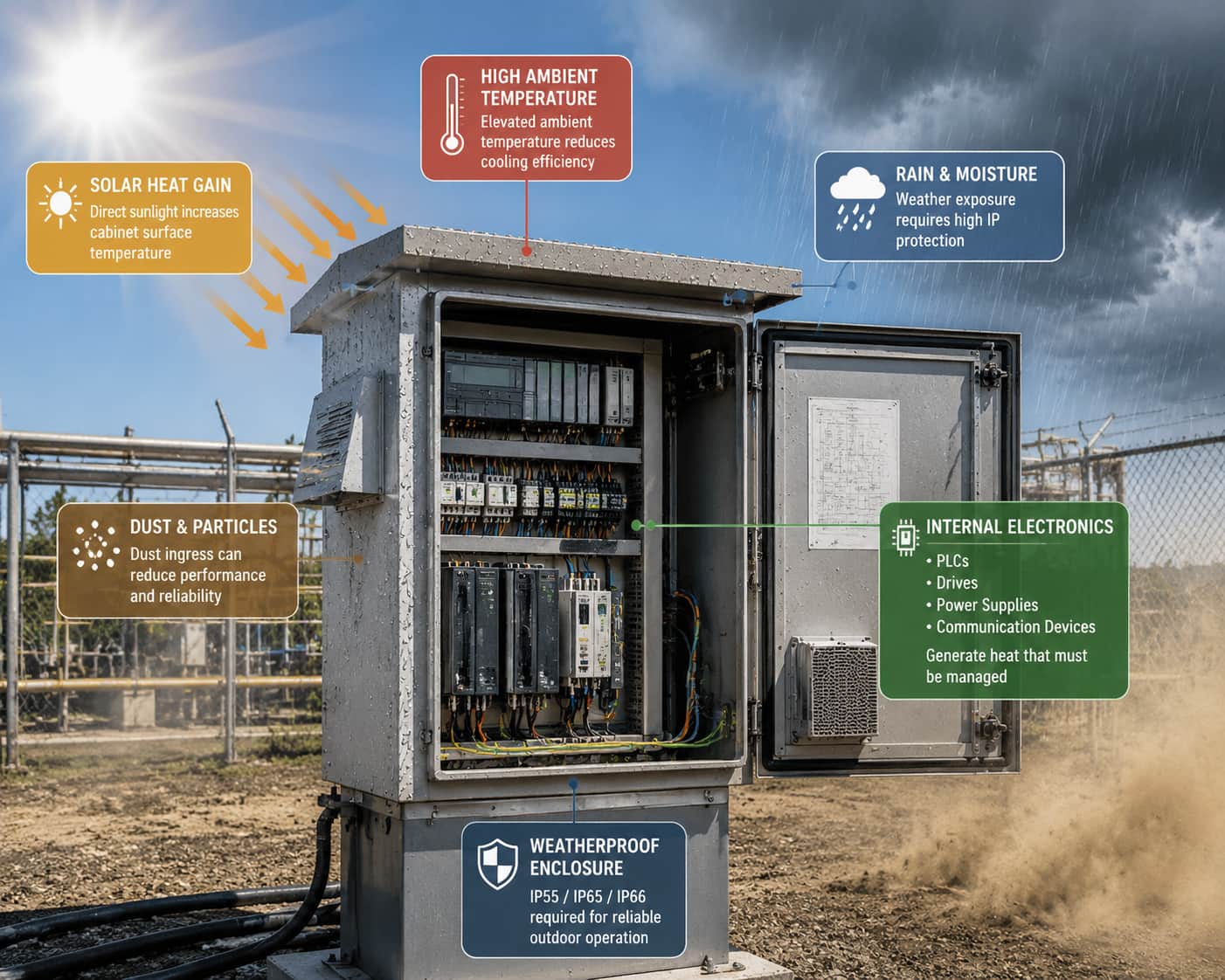
Its ambient temperature changes within a relatively narrow range, direct rain is absent, solar loading is negligible, and the quality of the surrounding air can often be managed. An outdoor cabinet has no such buffer. It must protect its controls while exposed to changing weather, sunlight, airborne contamination, and large day-to-night temperature swings.
That difference changes the engineering problem. Outdoor electrical cabinet cooling is not simply a matter of choosing a fan or air conditioner from a nominal capacity table. The designer must evaluate several mechanisms at the same time:
- Ambient temperature: The cooling system has to operate at the actual summer design temperature, not an annual average. Local hot spots near roofs, process equipment, walls, or dark paving may be hotter than the weather-station value.
- Solar radiation: Sunlight adds heat through the roof, door, and side panels. The effect depends on exposure, surface color, material, orientation, shading, and wind.
- Dust and moisture: Outdoor air may carry dust, salt, fibers, rain, mist, insects, or corrosive contaminants. Any system that exchanges enclosure air with ambient air creates a contamination path.
- Condensation risk: A sealed cabinet can still contain moisture. Temperature cycling, humid air entering during service, and cold internal surfaces can lead to water droplets even when rain never penetrates the enclosure.
- Electronic component reliability: PLCs, drives, power supplies, industrial PCs, and communication devices have temperature limits and derating requirements. Stable operation requires attention to the temperature at the component air inlet, not only the reading at one convenient sensor location.
The enclosure, seals, cable entries, cooling device, drains, and mounting cut-outs form one protective system. An empty enclosure's IP rating does not automatically apply after a cooling unit or vent is installed. Evaluate the completed assembly against the required protection level.
For a broader explanation of why this issue should be addressed during design rather than after commissioning, see why cabinet cooling has become a critical engineering decision.
Why Outdoor Electrical Cabinets Generate Excessive Heat
Almost every powered device in a control cabinet converts part of its input energy into heat. The heat loss of one small device may be modest, but modern cabinets combine control, communication, computing, and power conversion in a compact volume. Total heat dissipation can therefore become substantial.
Typical contributors include:
- PLCs and remote I/O: CPUs, I/O modules, backplanes, and communication modules generate continuous low-to-moderate heat. Dense mounting and limited spacing can create local hot zones.
- Variable frequency drives (VFDs): Power semiconductors, DC bus components, control electronics, and internal fans dissipate heat. Losses depend on drive rating, motor load, switching frequency, operating mode, and manufacturer data.
- Servo drives: Motion profiles may produce highly variable loads. Several axes accelerating and decelerating together can create peaks that are not represented by a simple average.
- Power supplies and UPS equipment: Conversion losses become cabinet heat. Battery performance and lifetime can also be temperature-sensitive.
- Industrial PCs and HMIs: Processors, storage devices, displays, and graphics hardware add heat, often close to door-mounted equipment or other restricted airflow zones.
- Communication devices: Managed switches, routers, gateways, radios, and power-over-Ethernet equipment may operate continuously and are easily overlooked in the heat balance.
Relays, transformers, line reactors, braking resistors, and bus connections add further losses. Where design and safety requirements allow, relocating suitable heat-producing equipment outside the cooled space can reduce cooling demand.
Use manufacturer-declared power-loss data at the intended operating point whenever possible. Nameplate input power is not the heat loss. For a power conversion device, a first-order estimate is:
Heat loss = input power − useful output power
Check this estimate against supplier data because efficiency changes with load. A component-by-component worksheet is more defensible than applying a generic percentage to the entire cabinet. See SUWIAUTO's article on heat generation inside electrical cabinets.
Excess temperature causes equipment derating or trips and accelerates aging of capacitors, insulation, batteries, displays, and semiconductor packages. Temperature gradients can also cause trouble before a cabinet-level alarm occurs: a drive inlet may recirculate hot air even if a remote sensor appears acceptable.
The practical consequences are nuisance faults, intermittent communication problems, reduced component lifetime, and unexpected downtime. These failures are often wrongly treated as isolated device problems. In reality, repeated faults across different electronic devices can indicate a shared thermal or airflow problem.
Major Thermal Challenges in Outdoor Electrical Cabinets
High Ambient Temperature
A passive enclosure can reject heat only when its internal temperature is higher than ambient. As the temperature difference narrows, passive heat transfer decreases. If the required cabinet temperature is below the maximum outdoor ambient temperature, natural ventilation and an air-to-air heat exchanger cannot achieve the target by themselves. Active refrigeration or another heat sink below the desired cabinet temperature is then required.
Cooling capacity must be checked at the specified ambient and internal temperatures. A unit's headline capacity may be stated at a favorable rating condition. At a hotter ambient condition, available capacity may fall while compressor power and thermal stress rise. Engineers should use the manufacturer's performance curves or selection software rather than comparing catalog capacity alone.
Also consider microclimate. A cabinet beside heat-rejecting equipment, on a rooftop, or above dark pavement can be hotter than a shaded weather measurement. Where project risk justifies it, measure near the proposed air inlet.
Solar Radiation and External Heat Gain
Solar gain is frequently the missing line in an outdoor cabinet heat calculation. A metal enclosure exposed to direct sun can absorb heat through multiple surfaces. Dark finishes generally absorb more solar energy than light, reflective finishes, although coating performance, aging, contamination, and project requirements must also be considered.
A simplified screening calculation may express absorbed solar heat as:
Solar heat gain ≈ solar absorptivity × incident solar irradiance × exposed projected area
This is only a screening calculation. Wind, convection, insulation, surface orientation, and time of day affect internal temperature. For important designs, use a validated manufacturer method or project-specific analysis.
Shading is effective when it preserves airflow and service access. A sun shield must not obstruct the cooling inlet or discharge. Insulation reduces daytime ingress but also reduces passive release of internal heat; include that trade-off in the thermal model.
Engineering example: Consider an outdoor control cabinet located near continuously operating production equipment. The cabinet receives afternoon sunlight while its drives and power electronics generate heat. The surrounding equipment also warms the local air. Selecting a cooling unit using only the site's published ambient temperature and internal electrical losses would omit both the solar load and the local temperature rise. The result could be a unit that runs continuously and still fails to maintain the component inlet temperature.
Dust, Water, and Environmental Protection Requirements
Outdoor control cabinet cooling must preserve the required environmental protection. With natural vents or filter fans, outside air enters the cabinet. Filters reduce particles within their rated capability, but they do not make an open-loop system equivalent to a sealed system. Fine dust, conductive contamination, salt aerosol, humidity, and corrosive gases may still make open ventilation unsuitable.
Also review wind-driven rain, washdown, snow, ice, drainage, cable-entry orientation, and door seals. Filters and louvers need an outdoor-suitable arrangement, with safe maintenance access.
IP ratings address access, solid objects, and water under defined tests. They do not establish corrosion, UV, or chemical resistance. Confirm the finished assembly's rating and review other environmental requirements separately.
Condensation and Humidity Control
Condensation occurs when a surface temperature falls below the dew point of the air around it. The risk is not limited to cold climates. A cabinet can cool rapidly after sunset while its internal air remains humid, or warm humid air can enter when a door is opened and then contact cooler components. An air conditioner set unnecessarily low may also create cold surfaces or condensate that must be managed correctly.
A practical condensation-control strategy may include:
- A thermostat- or hygrostat-controlled enclosure heater during cold or de-energized periods
- A cooling setpoint high enough to avoid unnecessary sub-dew-point operation while staying within component limits
- Controlled ventilation or a suitable breather arrangement when pressure equalization is required
- Intact door seals and properly sealed cable glands
- Correct condensate drainage or evaporation according to the cooling-unit instructions
- Door-open procedures and anti-condensation logic for humid service conditions
- Humidity and temperature monitoring at locations representative of vulnerable equipment
Any drain or breather affects enclosure protection and must be designed as part of the assembly. In freezing climates, prevent trapped condensate or blocked drainage.
Outdoor Electrical Cabinet Cooling Methods Comparison
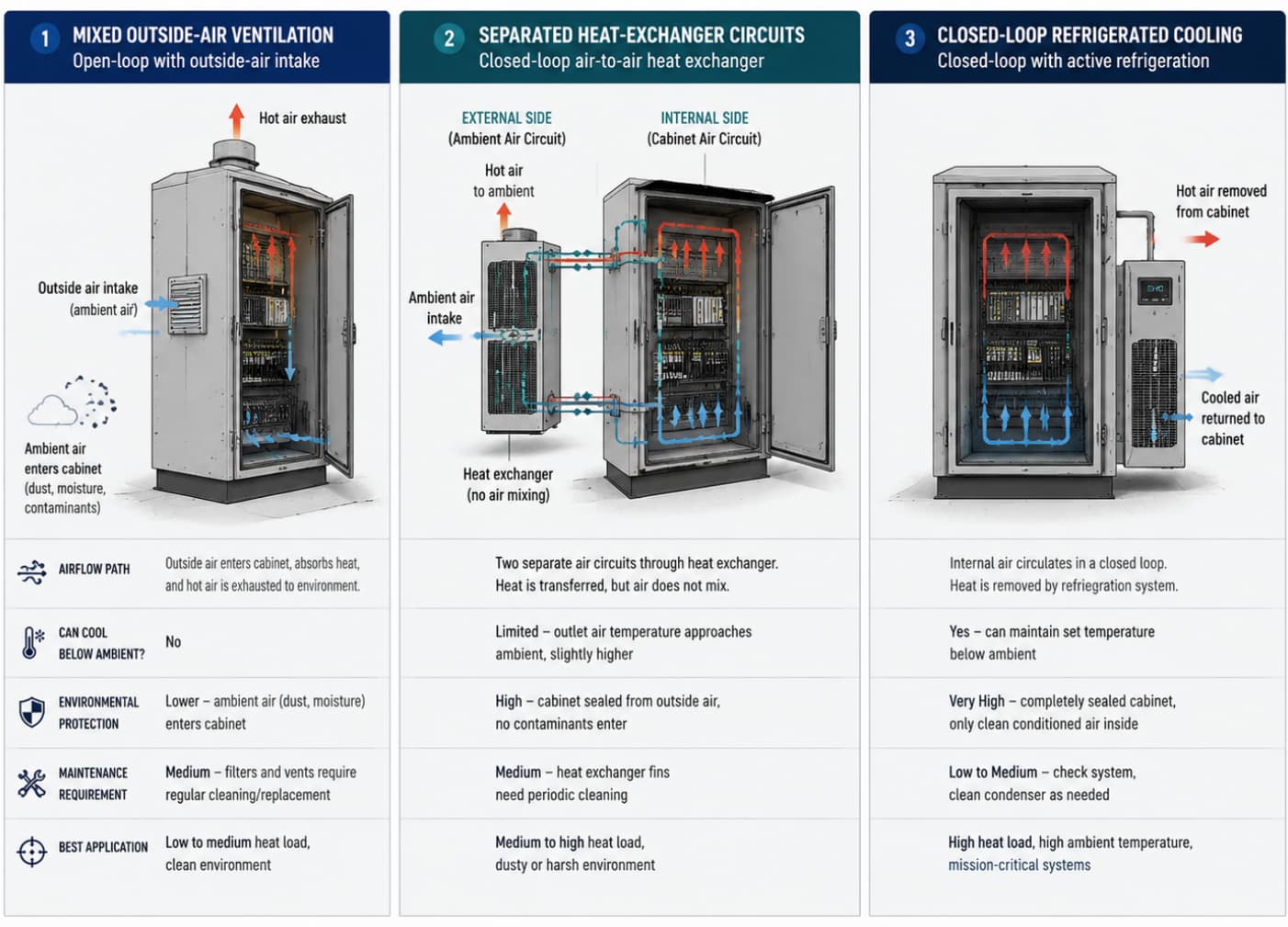
No single solution fits every installation. The choice depends on internal temperature, heat load, ambient range, contamination, protection, maintenance, and lifecycle cost.
| Method |
Air path |
Can cool below ambient? |
Main advantage |
Main limitation |
Typical fit |
| Natural ventilation |
Closed loop |
No |
Simple, low energy use |
Weak and weather-dependent heat removal |
Very low heat load; clean, mild, protected locations |
| Filter fans |
Closed loop |
No |
Cost-effective forced airflow |
Imports ambient air; filters need service |
Moderate heat load where air is clean and cooler than target |
| Enclosure air conditioner |
Closed loop |
Yes |
Handles high load and hot ambient conditions |
Higher energy use and maintenance complexity |
Sealed cabinets, sensitive electronics, demanding climates |
| Air-to-air heat exchanger |
Closed loop |
No |
Preserves separation from dusty ambient air |
Requires ambient below the desired internal temperature |
Dusty locations with a useful temperature difference |
| Advanced hybrid/variable control |
Closed loop |
Depending on system |
Load matching, monitoring, energy optimization |
Higher initial cost; application-specific payback |
Variable loads, long operating hours, energy-focused projects |
1. Natural Ventilation
Natural ventilation relies on buoyancy and wind-driven air exchange. Its advantages are simplicity, low purchase cost, no fan power, and few moving parts. It can be appropriate for very low internal heat loads when the ambient air is reliably cooler than the allowable cabinet temperature and the installation is protected from harmful contamination and water.
Outdoors, airflow changes with wind, temperature difference, vent placement, and blockage. The method cannot cool below ambient, and its open path may reduce environmental protection.
2. Filter Fans
Filter fans provide controlled forced airflow and are economical when ambient air is clean enough to enter the enclosure. A typical layout introduces cool air low in the cabinet and discharges warm air high on the opposite side, creating a sweeping flow through the equipment.
Advantages include low energy consumption, straightforward installation, and useful capacity when the ambient-to-cabinet temperature difference is favorable. Limitations include inability to cool below ambient, filter loading, contamination ingress, and sensitivity to blocked inlet or exhaust paths.
Base filter replacement on actual dust loading, not only a calendar. Provide safe access, inspection criteria, replacement media, and—where failure consequences warrant it—airflow or temperature alarms. Do not compare fan airflow ratings directly with refrigeration cooling capacities.
3. Air Conditioner for Electrical Cabinet
An enclosure air conditioner uses separate internal and external air circuits. It removes heat from recirculating cabinet air and rejects that heat to the environment without intentionally mixing the two air streams. This closed-loop arrangement supports sealed-cabinet protection and can maintain an internal temperature below ambient, subject to the unit's operating envelope.
It suits high loads, high ambient temperatures, sensitive electronics, or contaminated environments where open ventilation is unacceptable. Check performance at design conditions, voltage, mounting, clearances, condensate management, outdoor suitability, and protection after installation.
Avoid excessive oversizing: a large fixed-capacity unit may short-cycle, while an undersized unit may run continuously without reaching setpoint. Set the margin from load uncertainty, extremes, future expansion, and manufacturer guidance.
4. Air-to-Air Heat Exchanger
An air-to-air heat exchanger transfers heat between two isolated air circuits. Because cabinet air and ambient air remain separated, it is useful in dusty environments where a sealed cabinet must be protected. It normally has fewer refrigeration components and can offer low maintenance and energy use.
An air-to-air heat exchanger cannot reduce cabinet temperature below ambient, and its heat-transfer rate declines as internal and external temperatures converge. It fits conditions where ambient stays sufficiently below the allowable cabinet temperature.
5. Advanced Cabinet Cooling Technology
Advanced systems combine methods such as passive heat-pipe transfer, variable-speed refrigeration, electronically controlled fans, monitoring, and communications. Blue e+ cooling technology is one example of this direction. The engineering value is not the label itself; it is the ability to match cooling output to a changing load and to use lower-energy heat transfer when ambient conditions permit.
For applications with high heat density, variable loads, or strict energy requirements, advanced cooling technologies can provide better efficiency compared with fixed-output cooling systems.
Learn more about SUWIAUTO's Blue e+ Cooling Technology and how intelligent coling control improves industrial cabinet thermal management.
Potential benefits include part-load efficiency, tighter control, maintenance data, and fewer full-output cycles. Reliability still depends on correct sizing, clean heat-transfer surfaces, unobstructed airflow, and published operating limits.
The financial case depends on operating hours, load profile, energy cost, ambient distribution, maintenance, and initial price. Review SUWIAUTO's Blue e and Blue e+ enclosure cooling comparison. For smaller sealed cabinets, also see thermoelectric cooling in industrial enclosures; it is not automatically a replacement for compressor cooling.
How to Select the Right Outdoor Cabinet Cooling Solution
Step 1: Calculate Heat Load
List every heat-producing component at the worst credible simultaneous duty, using manufacturer loss data where available. Include drives, power supplies, transformers, resistors, computers, networking, lighting, and future capacity. Separate continuous load from short peaks.
Then assess passive enclosure heat transfer. Area, material, mounting, insulation, and temperature difference matter.
For preliminary selection, the design requirement can be expressed as:
Cooling requirement = internal heat generation + solar heat gain + design safety margin
This conservative expression is useful when passive enclosure heat rejection has not been credited. If a validated calculation already includes heat transfer through enclosure surfaces, do not add or subtract the same effect twice. Document assumptions so another engineer can reproduce the result.
Step 2: Evaluate Ambient Conditions
Define temperature extremes, solar exposure, humidity, dew point, altitude, contaminants, precipitation, vibration, and nearby heat sources during operation and shutdown. Use manufacturer altitude corrections where applicable.
Step 3: Determine Protection Requirements
Specify the required IP level and any corrosion, material, washdown, UV, or hazardous-location requirements applicable to the project. Confirm compatibility of the enclosure, cooling device, seals, cable entries, and all cut-outs as an installed assembly. A cooling component's rating should not be transferred automatically to the complete cabinet.
Step 4: Select the Cooling Method
Use a sequence of engineering questions:
- 1. Is ambient air clean and dry enough to enter the enclosure?
- 2. Is the maximum ambient temperature below the permitted cabinet temperature with adequate margin?
- 3. Can passive heat transfer or forced ventilation remove the calculated load?
- 4. Must the cabinet remain sealed?
- 5. Is cooling below ambient required?
- 6. Does the load vary enough to justify modulating or hybrid technology?
Open-loop ventilation is viable only if the first two conditions are favorable. A heat exchanger protects a sealed cabinet but still needs ambient below the internal target. An enclosure air conditioner becomes the practical choice when the cabinet must remain closed and its required temperature cannot be maintained by ambient-dependent heat transfer.
Step 5: Consider Maintenance and Lifecycle Cost
Include energy at realistic part load, filter and coil service, access time, spares, alarms, condensate management, and downtime cost. Remote critical assets may justify monitoring or redundancy; an accessible noncritical cabinet may not.
Finally, verify the proposed model against the manufacturer's performance data at the project's voltage, frequency, ambient temperature, cabinet setpoint, and mounting arrangement. Recheck airflow after the internal layout is frozen.
Common Outdoor Electrical Cabinet Cooling Mistakes
Mistake 1: Ignoring Solar Radiation
Using only internal electrical loss and weather-station temperature understates the load on an exposed cabinet. Include solar gain, cabinet orientation, surface finish, and local shading. If a sun shield is added, confirm that it does not recirculate condenser exhaust air.
Mistake 2: Selecting Insufficient Cooling Capacity
Catalog capacities are condition-dependent. A unit selected exactly at a nominal rating may have inadequate capacity at the site's maximum ambient temperature. Apply a justified margin and check the actual performance curve, not only the model name.
Mistake 3: Using Open Ventilation in Harsh Environments
Filter fans can be excellent in clean locations, but they deliberately move outside air through the electronics. Fine conductive dust, salt, moisture, oil mist, or corrosive gas can make the low initial cost expensive over the equipment lifecycle.
Mistake 4: Ignoring Condensation Protection
Cooling addresses high temperature; it does not automatically control every humidity condition. Review dew point, door opening, shutdown cycles, low nighttime temperatures, heater control, and condensate routing as a separate design task.
Mistake 5: Poor Airflow Design
A cooling unit cannot protect components if supply air short-circuits directly back to its return. Keep internal air paths open, respect component spacing, separate hot exhaust from cool inlets, and avoid placing large wire ducts or document pockets across critical flow paths. Position sensors where they represent the thermal risk. After commissioning, use temperature measurements at critical device inlets to confirm the design assumptions.
Outdoor Electrical Cabinet Cooling Applications
Renewable Energy Systems
Renewable energy sites combine variable loads, solar exposure, and limited access. Selection should reflect the daily temperature/load profile, contamination, communications, and consequences of remote failure.
Solar Inverter Cabinets
In solar inverter cabinets, electrical load and solar gain may peak together. Use inverter loss data at realistic output and prevent condenser-discharge recirculation.
Water Treatment
Water facilities may expose cabinets to humidity, splash, corrosive gases, and temperature swings. Closed-loop cooling, materials, coatings, seals, and maintenance must match the site chemistry.
Industrial Automation
Outdoor automation may combine VFDs, PLCs, safety controls, and networking. Duty and dust vary widely, so select from measured or specified conditions rather than an industry label.
Remote Monitoring Systems
Remote-monitoring cabinets may have modest loads but strict uptime needs. Heat exchangers or thermoelectric devices may fit their operating range, while remote temperature, humidity, fan, and door data can support maintenance.
Outdoor Control Stations
Operator stations introduce door-mounted displays, pushbuttons, and frequent human interaction. Solar loading on a display can affect readability and temperature, while repeated door opening introduces humid or contaminated air. Canopies, layout, cooling airflow, and service procedures should be coordinated from the start.
Across these applications, SUWIAUTO's role is to help engineers and procurement teams compare enclosure and thermal-management options against documented heat load, environment, protection, installation, and lifecycle requirements. Final suitability depends on the selected equipment's technical data and the project's actual operating conditions.
Related Cabinet Cooling Resources